
The New Zealand dollar gained against the greenback yesterday after Statistics New Zealand reported a trade surplus for February. The antipodean currency was also lifted by positive news relating to the US-China trade talks as China is the largest trading partner of New Zealand. The positive economic data and geopolitical developments have enabled the NZD/USD to reverse from a low of 0.6870 to record a high of 0.6920 in the past 24 hours.
Unexpected trade surplus push the Kiwi dollar higher
Statistics New Zealand reported a trade surplus of N$12 million in February, topping analysts’ expectations for a deficit of N$200 million. In January, the country recorded a deficit of N$914 million.
Exports jumped 8.3% or N$371 million y-o-y to N$4.8 billion, an increase from N$4.4 billion in the earlier month, and surpassing economists’ forecasts for N$4.7 billion. Exports of milk powder, butter, and cheese increased 24% y-o-y to N$263 million to N$1.3 billion. Export value of milk powder grew 28% y-o-y or N$155 million to reach N$709 million. Shipment quantity increased 23% on a y-o-y basis.
Shipment of edible offal and meat increased 11% or N$81 million to N$839 million and posted a new record for any month.
Imports increased 13% or N$547 million to NZ$4.8 billion, versus analysts’ estimates for N$4.9 billion. Last month, the country’s import bill was N$5.32 billion. Import of vehicles, spare parts, and other accessories increased 27% y-o-y or N$133 million to N$634 million. In particular, motor vehicle imports increased by N$93 million.
By the end of February, yearly goods exports were N$57.70 billion, while goods imports were N$64.30 billion. Overall, the country recorded an annual trade balance deficit of N$6.60 billion.
Following a solid production season and a revived rise in meat and dairy prices, export performance in the major industry continues to exceed forecasts for the year ending June 2019.
The Situation and Outlook for Primary Industries report from the Ministry of Primary Industries’ indicated that export revenue for the year ending June 2019 is now anticipated to be $45.6 billion – 6.9% higher than the earlier year and 3% higher than the MPI’s December outlook.
The positive trade data enable the Kiwi dollar to strengthen against the greenback. The uptrend was further aided by positive news related to the US-China trade talks.
Chinese Vice-Premier Liu He, Beijing’s chief trade negotiator, is scheduled to visit Washington in early April to pursue and very likely complete the trade talks. China has also promised to allow foreign companies to start providing financial services, which is presently controlled by the state.
The China-US talks have reached a critical stage, with the remaining stumbling blocks anticipated to be addressed in the draft of a trade deal when the US Treasury Secretary Steven Mnuchin and trade representative Robert Lighthizer visit Beijing on Thursday.
Regarding the decision to allow overseas companies to offer financial services, Yi Gang, governor of the People’s Bank of China, said “Our conclusion is that further opening up will do more good than harm. All these [opening up steps] are in China’s own interests.”
Meanwhile, US Attorney General William Barr said a nearly two-year inquiry by special prosecutor Robert Mueller did not find enough proof to make a specific case against Trump in destroying 2016 election-related evidence or running the campaign in coordination with Russia. The Mueller report has put President Donald Trump in a stronger position. Therefore, analysts believe that China has more economic incentive to reach an agreement on US trade.
Michael Hirson, Asia director at consulting firm Eurasia Group, said: “The Mueller report isn’t a game-changer, but it should encourage China to keep up recent momentum in trying to finalize a deal with Trump.”
The facts presented above are expected to keep the Kiwi dollar bullish.
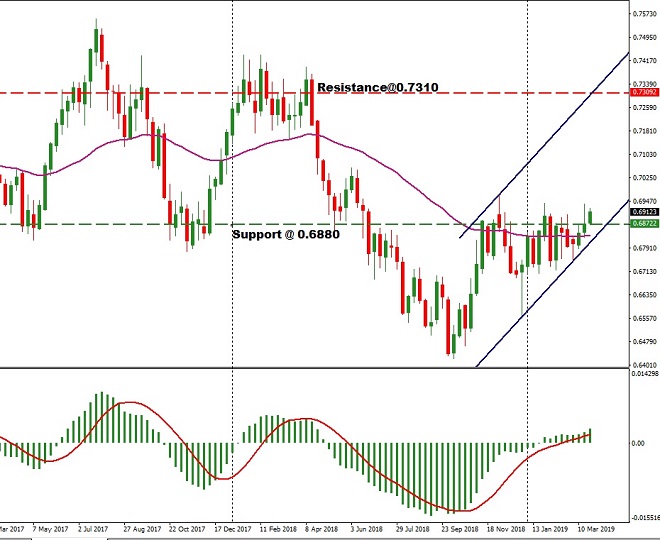
Technically, the NZD/USD pair has found support at 0.6880. Additionally, the currency pair is also moving along the ascending channel as shown in the image below. The MACD indicator also has a positive reading. As a result, we can expect the currency pair to remain bullish in the short-term.
Disclaimer: Any financial trading analysis offered here is our opinion and is not intended as advice or direction for investors. We cannot guarantee the success of any trades made as a consequence of this article, and we encourage traders to incorporate a strong money management strategy to limit losses when they enter the markets. Please use this article as part of your own research before formulating strategies prior to trading.