
The yen remained range-bound against the greenback yesterday despite reports of better-than-anticipated industrial production and retail sales data for July. The US non-farm payroll data missed estimates by a wide margin. Still, the greenback held ground as the reaffirmation of the hawkish stance by the Fed has stirred up the demand for the US dollar. Overall, the USD/JPY pair traded in a narrow range of between 138.29 and 138.90 in the last 24 hours.
According to the preliminary data published by Japan’s Ministry of Economy, Trade, and Industry (METI), the country’s industrial production grew by 1% m-o-m in July, following a 9.20% rise in the prior month, and delighted economists who were expecting a 0.50% contraction for the reported month.
Motor vehicle production surged 12% in July, following a 14.10% jump in June. General-purpose and business-oriented machinery production grew by 8.60%, following a decline of 0.40%. Production machinery increased 5.90%, following a rise of 9%. However, the production of electronic parts and devices plummeted by 9.20%, primarily due to the declining output of memory chips. The data indicates the steepest one-month drop since February 2013. In June, electronic parts and devices production jumped 11.60%.
On a year-over-year basis, industrial output declined 1.80% in July, following a 2.80% decrease in June. The figure reflects the fifth successive month of decline.
Notably, prominent auto manufacturer Toyota Motor Corp. stated that its worldwide vehicle production had declined 8.60% year over year in July, missing its production goal for the fourth successive month.
Also, manufacturers polled by METI forecast output to grow by 5.50% in August and 0.80% in September.
According to the data published by METI, the country’s retail sales grew by 2.40% y-o-y in July, following a 1.50% rise in the prior month and greater than the 1.90% increase anticipated by economists. The reported reading reflects the fifth successive month of growth in retail trade.
General merchandise sales rose by 4.60% in July, following a 4.50% growth in June. Fuel prices increased 8.10% in July, from 11.80% in June. Medicine and toiletries surged 8.60%, from 4.60%.
On the downside, motor vehicle sales fell by 2.40% in July, following a drop of 8.10% in June. Machinery & equipment decreased 5.50%, following a growth of 0.40%.
On an m-o-m basis, retail trade grew by 0.80% in July, following a 1.3% decline in June.
According to the data published by Automatic Data Processing, Inc., the US non-farm payrolls increased by 132,000 in August, following an addition of 270,000 jobs in the prior month, but missed the 300,000 job additions anticipated by economists.
Goods-producing industries added 23,000 jobs. Specifically, the construction sector recorded an addition of 21,000 jobs. The service-providing sector reported an addition of 110,000 jobs. In particular leisure/hospitality sector added 96,000 jobs. Trade/transportation/utilities added 54,000 jobs. However, sectors focused on financial activities lost 20,000 jobs.
Small establishments added 25,000 jobs, while medium-level firms added 53,000 jobs. Large enterprises recorded an addition of 54,000 jobs.
The USD/JPY pair is expected to remain range bound in the short term, in spite of robust Japanese economic data as the reaffirmation of the hawkish stance by the Fed continues to bolster the greenback.
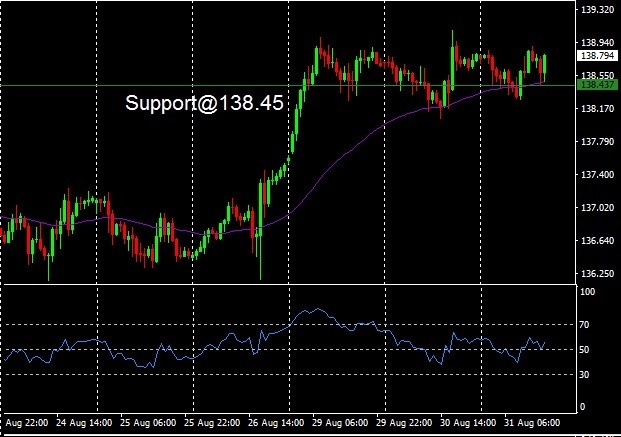
The historical price chart indicates that the USD/JPY pair is consolidating at 138 levels. The currency pair is trading above its 50-day moving average while the RSI indicator is showing a reading above 50. Therefore, we anticipate the currency pair to remain in an uptrend in the near term.
Disclaimer: Any financial trading analysis offered here is our opinion and is not intended as advice or direction for investors. We cannot guarantee the success of any trades made as a consequence of this article, and we encourage traders to incorporate a strong money management strategy to limit losses when they enter the markets. Please use this article as part of your own research before formulating strategies prior to trading.