
The Aussie fell against the greenback yesterday despite the release of better-than-anticipated consumer price index data for the March 2022 quarter. Notably, there were a series of poor economic data from the US, including widened trade deficit, a decline in pending home sales, and higher than anticipated wholesale inventories. Still, the anticipation of a 50-basis point rate hike by the US Fed next week continues to keep the greenback bullish against its peers, including the Australian dollar. Overall, the AUD/USD pair declined from a high of 0.7190 to a low of 0.7110 in the last 24 hours.
According to the data published by the Australian Bureau of Statistics, the country’s consumer price index (CPI) rose by 2.10% q-o-q in the March 2022 quarter, following an increase of 1.30% in the prior quarter and greater than the reading of 1.70% anticipated by economists.
On a y-o-y basis, the CPI surged 5.10% in the March 2022 quarter, aided by higher dwelling construction expenses and automotive fuel prices.
Trimmed mean CPI increased 1.40% q-o-q in the first quarter of 2022, following a rise of 1% in the earlier quarter and better than the 1.20% growth anticipated by economists.
Trimmed mean annual inflation, devoid of large price rises and decreases, increased 3.70%, the highest since March 2009. With a 4% rise, grocery food products were the main contributor to the food group in 1Q 2022.
According to the data published by the US Census Bureau, the country’s goods trade deficit widened to $125.30 billion in March, from $106.60 billion in February and disappointed economists who were anticipating a narrowing of the trade deficit to $105 billion.
Goods exports were $169.30 billion in March, an increase of $11.40 billion (or 7.20%) from the prior month. Imports of goods rose by $30.30 billion m-o-m (or 11.50%) to $294.60 billion in March.
Exports of industrial supplies increased 12.30% in March. Likewise, capital goods posted a rise of 1.70%. Imports of consumer goods increased by 13.60%. Capital goods rose by 7.60%. Also, industrial supplies imports posted a growth of 15%.
According to the preliminary data published by the Census Bureau, preliminary wholesale inventories increased 2.30% m-o-m to $837.70 billion in March, following a 2.60% rise in the prior month and disappointed economists who were anticipating only a 1.50% growth in wholesale inventories.
On a y-o-y basis, wholesale inventories surged by 21.50% in March 2022.
Retail inventories grew by 2% m-o-m to $684.30 billion in March, compared with a 1.50% rise in February. On a y-o-y basis, retail inventories jumped 11% in March 2022.
The National Association of Realtors stated that pending home sales declined 1.20% m-o-m in March, following a decrease of 4.10% in the prior month and worse than the 1% drop anticipated by economists. Correspondingly, the pending home sales index stood at 103.70 in March. The reported figure represents the fifth consecutive month of decline in pending home sales.
On a y-o-y basis, pending home sales fell by 8.20%.
Lawrence Yun, NAR’s chief economist, said, “Overall existing-home sales this year look to be down 9% from the heated pace of last year.”
Yun expects the 30-year fixed mortgage rate to hit 5.3% by 4Q22. He also anticipates inflation to average 8.20% this year, despite easing to 5.50% in the second half of 2022. Furthermore, Yuan forecasts the jobless rate to average 3.70% and the economy to expand 2.80% in 2022.
The weak economic data from the US coupled with hawkish rate hike expectations are expected to keep the AUD/USD pair range-bound with a slight bearish bias in the short term.
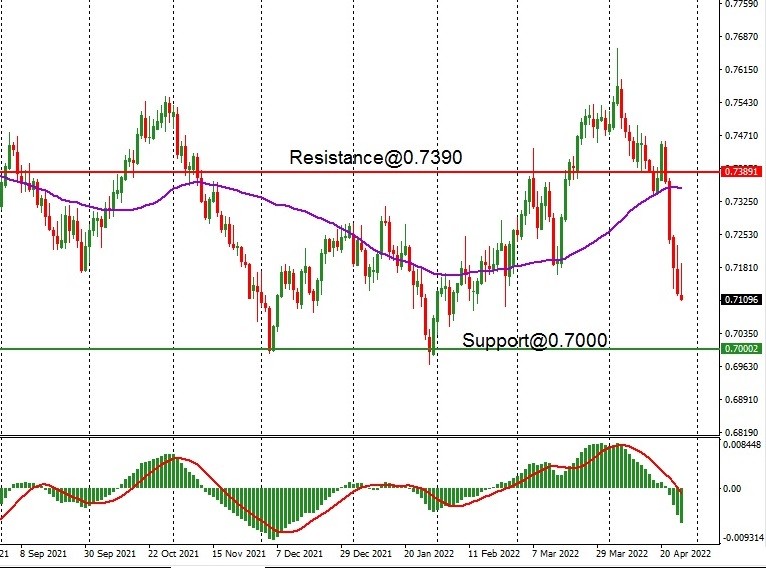
The historical price chart indicates that the AUD/USD pair is declining after facing resistance at 0.7390. The next major support is anticipated only near 0.7000. Additionally, the currency pair is trading below its 50-day moving average, while the MACD indicator is extending in the negative zone. Therefore, we are anticipating the currency pair to remain in a downtrend in the short term.
Disclaimer: Any financial trading analysis offered here is our opinion and is not intended as advice or direction for investors. We cannot guarantee the success of any trades made as a consequence of this article, and we encourage traders to incorporate a strong money management strategy to limit losses when they enter the markets. Please use this article as part of your own research before formulating strategies prior to trading.