Yesterday, the British pound started forming new daily lows in the early European session after the release of poor UK manufacturing and GDP data. The Sterling also saw an increase in selling pressure caused by the uncertainty surrounding the Brexit issue. Only 45 days are left for the UK to exit the European Union. From a high of 1.2960, the GBP/USD pair dropped to a low of 1.2857 and continues to trade near that level.
Weak economic data, Brexit uncertainty traps the pound
Official figures indicate that the UK economy has slowed to its lowest growth rate in six years in the midst of growing uncertainty about Britain’s imminent exit from the European Union.
Data released by the UK Office for National Statistics (ONS) divulged that the British economy expanded by 1.4% in 2018, compared to 1.8% in the previous year, highlighting a loss of momentum in a range of industries, including construction and automotive production.
The figure represents the lowest annual growth rate in the UK since 2012, which also saw a 1.4% growth. It was the worst performance since 2009 when the economy contracted by 4.2% following a global economic downturn that drove down most of the world’s banking system.
The statistics agency also stated that the country’s economy expanded by 0.2% in the December quarter and missed economists’ expectations by 0.1%. In the previous quarter, the UK GDP grew by 0.6%.
Phillip Hammond, Chancellor of the Exchequer, said the ONS data indicated a “solid performance” in the midst of the worldwide economic slowdown, but admitted that the UK economy was “overshadowed by the uncertainty” formed by the ongoing Brexit issue.
In an interview with Sky News, Hammond said: “The sooner we can resolve that, the better, the quicker we can get back to more robust growth in the future.”
The latest manufacturing production data published at the same time by the ONS also failed to meet expectations by recording a 0.7% contraction versus economists’ expectation of 0.2% expansion. The combined economic data releases sparked the pound sell-off that led the cable to plunge below the crucial 1.2900 support level.
Market sentiment towards the GBP/USD pair remained relatively cautious as there was no specific news related to Brexit. In the US session, the pair declined further downwards with the US Dollar Index recording a high of 97.08. The weak economic data and lack of positive news related to Brexit are expected to keep the GBP/USD pair in a downtrend.
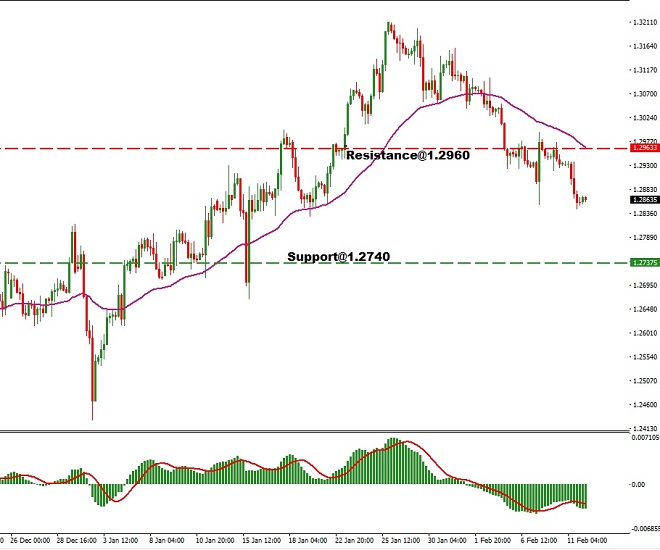
Technically, the GBP/USD pair is declining after failing to stay above the level of 1.2960. Furthermore, the currency pair is trading below its 50-day moving average. The MACD indicator has a negative reading as well. As a result, we are expecting the GBP/USD to move down further. The next major support for the currency pair exists only at 1.2740.
Disclaimer: Any financial trading analysis offered here is our opinion and is not intended as advice or direction for investors. We cannot guarantee the success of any trades made as a consequence of this article, and we encourage traders to incorporate a strong money management strategy to limit losses when they enter the markets. Please use this article as part of your own research before formulating strategies prior to trading.