

The Canadian dollar rallied against the yen yesterday following the Bank of Japan’s decision to hold on to its ultra-loose monetary policy. The economic data from Japan was much better than expected. However, the market was focused on the monetary policy decisions of the Bank of Japan. This enabled the CAD/JPY pair to rally from a low of 98.47 to a high of 100.67 in the past 24 hours.
Japan’s Statistics Bureau stated that Tokyo’s (Ku-area) core consumer price index increased 3.50% y-o-y in April from 3.20% in the previous month. Economists did not anticipate any change in the previous reading. Notably, for the 11th successive month, the reported figure was also higher than the Bank of Japan’s target level of 2%, indicating widening inflationary pressure in the country.
The reading also underlines the issues faced by BoJ (Bank of Japan) Governor Kazuo Ueda as the market continues to apply pressure on the central bank to shift from the prevailing ultra-loose monetary policy. However, the BoJ executives consistently maintain that the central bank will not withdraw the massive stimulus program until robust demand is recorded and the inflation level comes down to about 2%.
In a separate news release, Japan’s Statistics Bureau stated that the country’s unemployment rate inched up to 2.80% in March from 2.60% in the previous month, disappointing economists who were expecting a slight decline in the jobless rate to 2.50%.
The reported reading is the highest since January 2022, with the count of unemployed individuals rising by 150,000 to 1.95 million, reflecting the highest level since February 2021. Employment, however, rose by 170,000 to 67.31 million. The labor force participation rate stood at 62.60% in March 2023, unchanged from the March 2022 level. The jobs-to-application ratio declined to a seven-month low of 1.32 in March from 1.34 in February.
According to the preliminary data published by the Ministry of Economy, Trade, and Industry (METI), the country’s industrial production rose by 0.80% m-o-m in March, following a 4.60% growth in February and more than double the 0.40% increase anticipated by economists. On a y-o-y basis, the industrial production of the third-largest economy fell by 0.70% in March 2023.
The METI also stated that the country’s retail sales rose by 7.20% y-o-y in March, following a 7.30% growth in the previous month, surpassing forecasts of a 6.50% increase. The reported figure reflects the 13th successive month of growth as consumer expenditure continues to recover from the slump created by the pandemic.
The increase was led by automobiles, which grew by 21%. Likewise, retailers recorded an increase of 16.70%. Also, pharmaceutical and cosmetic retailers posted a growth of 10.30%. While food and beverages posted an increase of 5.10%, textiles, and clothing recorded a rise of 1.90%.
On the contrary, machinery and equipment reported a decline of 4.30%. Also, fuel posted a drop of 3.20%.
On an m-o-m basis, Japan’s retail sales inched up 0.60%, reflecting the fourth successive month of growth.
At the end of a two-day monetary policy meeting, the Bank of Japan, as anticipated by the market, left the benchmark interest rates unchanged at -0.10%. Notably, this is the first policy meeting under newly appointed Governor Kazuo Ueda. The benchmark interest rate has remained in negative territory since 2016.
Furthermore, the central bank also left the fluctuating range for 10-year Japanese government debt unaltered at 50 bps over and below the target level of 0%.
With respect to current monetary policies, the central bank stated that it will carry out a review of its easing initiatives, and the time frame for the same is about one to 1½ years. The BoJ also forecast core inflation to be about 2.50% for FY23. For FY24 and FY25, the central bank expects core inflation, which is devoid of volatile goods such as food and energy, to be in the range of 1.50% to 2%.
According to Statistics Canada, the country’s economy increased by 0.10% m-o-m in February, following a 0.60% rise in January and a notch lower than the 0.20% GDP growth anticipated by economists. Services-producing industries and goods-producing industries inched up 0.10%. On the whole, 12 out of 20 subsectors recorded growth.
The public sector recorded a growth rate of 0.20% m-o-m in February, reflecting the 13th successive month of expansion with increases in the educational, healthcare, and social assistance sectors. Likewise, the professional, scientific, and technical services sectors grew by 0.60% m-o-m in February, as seven out of nine subsectors recorded gains.
Notably, the construction sector inched up 0.30% m-o-m in February as all subsectors posted growth for a second successive month. Specifically, residential building construction grew by 0.30%, mirroring a second successive growth cycle.
While finance and insurance increased by 0.3% m-o-m in February, wholesale trade contracted by 1.30% in the same period. Also, retail trade fell by 0.50%m-o-m in February. Similarly, general merchandise stores recorded a decline of 3.30%. More importantly, the manufacturing sector contracted 0.10%m-o-m in February.
As per advance data, Canada’s economy contracted 0.10% m-o-m in March.
The Bank of Japan’s decision to hold on to its stimulus program is expected to keep the yen slightly weaker against its peers, including the Canadian dollar, in the short term.
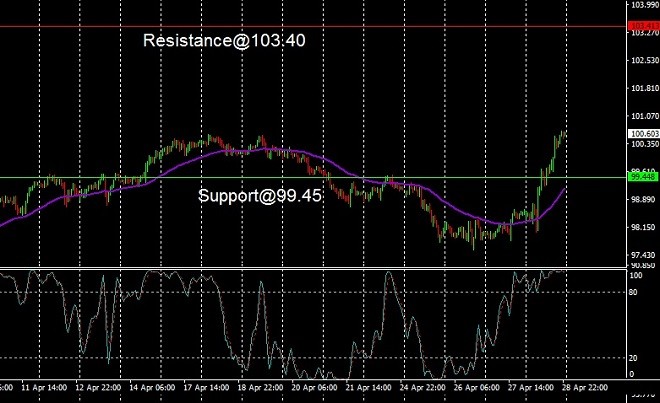
Technically, the CAD/JPY pair is rising after testing support at 99.45. The next resistance is anticipated only near 103.40. Additionally, the currency pair is trading above its 50-day moving average, while the stochastic indicator is in the bullish zone. Therefore, we anticipate the CAD/JPY pair to remain in an uptrend in the days ahead.
Disclaimer: Any financial trading analysis offered here is our opinion and is not intended as advice or direction for investors. We cannot guarantee the success of any trades made as a consequence of this article, and we encourage traders to incorporate a strong money management strategy to limit losses when they enter the markets. Please use this article as part of your own research before formulating strategies prior to trading.


