
The Aussie remained range-bound against the yen yesterday despite the release of upbeat Japanese economic data. The unexpected rate hike coupled with the hawkish statement by the RBA earlier this week enabled the Aussie to hold its ground against the yen. Overall, the AUD/JPY pair traded in a narrow range of 92.85 and 93.45 in the past 24 hours.
According to the Australian Bureau of Statistics, the country’s trade surplus declined to A$11.16 billion in April from A$14.82 billion in March and missed forecasts of A$13.65 billion. The reported figure reflects the smallest trade surplus since January.
Goods and services exports declined 5% (or A$2.96 billion) in April to a nine-month low of A$56.18 billion. The decrease was led by metal ores and minerals. Also, goods and services imports grew by 1.60% (or A$703 million) in April to a three-month high of A$45.02 billion. The increase was mainly led by civil aircraft.
According to the data published by the Bank of Japan, the value of loans given by banks rose by 3.40% y-o-y in May from 3.20% in the previous month, which pleased the market, which was expecting only a 3.10% rise in bank lending. The reported figure reflects the quickest pace of growth in two years as the world’s third-largest economy goes through an economic rebound. Outstanding loans owned by Japan’s top, domestic, and “shinkin” banks were ¥602.3 trillion. The overall lending growth was led by major and domestic banks, growing by 4% and 3.60%, respectively. The “shinkin” banks added 1.10%.
Japan’s current account surplus declined to ¥1.895 trillion in April from ¥2.278 trillion in March and surpassed forecasts of ¥1.66 trillion. In April 2022, Japan recorded a current account surplus of ¥1.075 trillion. The reported figure reflects the third successive monthly increase on a y-o-y basis. The primary income surplus rose to ¥3.067 trillion in April 2023 from ¥2.74 trillion in April 2022.
During the same period, the goods deficit narrowed to ¥113.14 billion from ¥684.10 billion. Exports rose by 2.60% y-o-y while imports declined by 4.10%. Additionally, the services account deficit narrowed to ¥646.50 billion from ¥1.002 trillion in the previous year. The secondary income deficit rose to ¥411.10 billion from ¥212.20 billion.
According to the final data published by Japan’s Cabinet Office, the country’s economy grew by 0.70% q-o-q in the March 2023 quarter, following a 0.40% increase in the December 2022 quarter and a few notches higher than forecasts of 0.50% growth. The preliminary estimates had pegged Japan’s economic growth at 0.40% in the first quarter.
Capital spending grew by 1.40% q-o-q in Q1 2023, up from 0.90% and in line with the data published by the Ministry of Finance that indicated the increase in business spending at the quickest pace since 2015.
Private consumption, which accounts for over 50% of Japan’s GDP, rose by 0.50%, downwardly revised from the preliminary estimate of a 0.60% rise. Domestic demand contributed 1% to 1Q23 GDP growth.
The solid Japanese economic data and the hawkish Reserve Bank of Australia’s rate hike announcement earlier this week are expected to keep the AUD/JPY pair range bound in the short term.
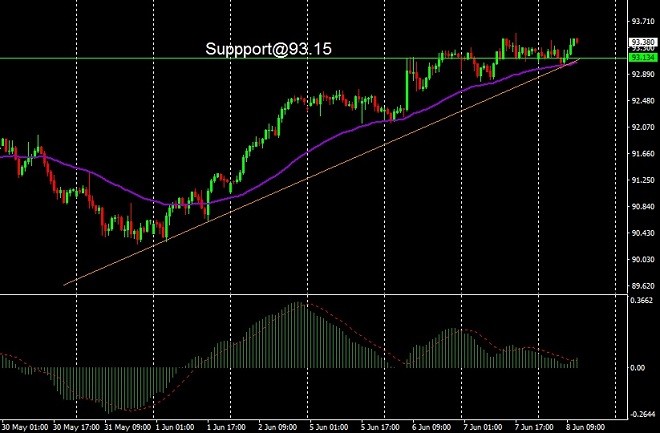
The historical price chart indicates that the AUD/JPY pair has broken the ascending triangle. The base of the ascending triangle is now expected to act as support. The next resistance is anticipated only near 94.65. Additionally, the currency pair is trading above its 50-day moving average while the MACD indicator is showing a positive reading. Therefore, we anticipate the AUD/JPY pair to remain in an uptrend in the short term.
Disclaimer: Any financial trading analysis offered here is our opinion and is not intended as advice or direction for investors. We cannot guarantee the success of any trades made as a consequence of this article, and we encourage traders to incorporate a strong money management strategy to limit losses when they enter the markets. Please use this article as part of your own research before formulating strategies prior to trading.


