
The Aussie remained rangebound against the Kiwi dollar yesterday despite the release of weak economic data from New Zealand. While Australia’s inflation data (March quarter) exceeded forecasts, New Zealand’s trade deficit unexpectedly widened in March. Overall, the AUD/NZD pair traded in a narrow range of 1.0764 and 1.0798 in the past 24 hours.
According to Statistics New Zealand, the country’s trade deficit widened to N$1.273 billion in March from N$796 million in February, disappointing economists who were expecting a decline in the trade deficit to N$500 million. In March 2022, the New Zealand trade deficit was $590 million.
Compared with March 2022, goods exports rose by N$40 million (0.6%) to N$6.5 billion. Milk powder, butter, and cheese exports declined by N$136 million (or 7%) to N$1.8 billion.
Likewise, goods imports grew by N$719 million (or 10%), to N$7.8 billion in March 2023. Petroleum and product imports increased by N$630 million (or 99%) to N$1.3 billion.
According to the Australian Bureau of Statistics, the country’s consumer price index rose by 1.40% q-o-q in the March 2022 quarter, following a 1.90% increase in the previous quarter and a notch higher than the 1.30% growth forecast by economists.
On a y-o-y basis, Australia’s inflation stood at 7% in the March 2023 quarter. However, it was lower than the three-decade high of 7.80% recorded in the December 2022 quarter.
Medical and hospital service-related prices recorded an increase of 4.20% in the March 2023 quarter. Tertiary education grew by 9.70%. Gas and other household fuels posted a rise of 14.30%. Domestic holiday travel and accommodation jumped 4.70%.
Trimmed mean annual inflation, which is devoid of steep increases or decreases in prices, was 6.60% in the latest quarter, a decline from 6.90% in the December 2022 quarter.
After two years of consistent rise, goods annual inflation fell from 9.50% to 7.60%, primarily due to a discount on furniture, clothes, and appliances in the March 2022 quarter and a decline in automotive fuel prices.
Services annual inflation recorded its largest annual rise since 2001, driven by higher prices for holiday travel, medical services, rents, and restaurant meals. Services annual inflation recorded its largest annual rise since 2001, driven by higher prices for holiday travel, medical services, rents, and restaurant meals.
The yearly food inflation slowed down to 8% in 1Q 2023, a decline from 9.20% in 4Q 2022.
Automotive fuel prices declined 0.80% in the March 2023 quarter. Specifically, diesel prices decreased by 10.30%.
The weak economic data from both countries are expected to keep the AUD/NZD pair range-bound in the short term.
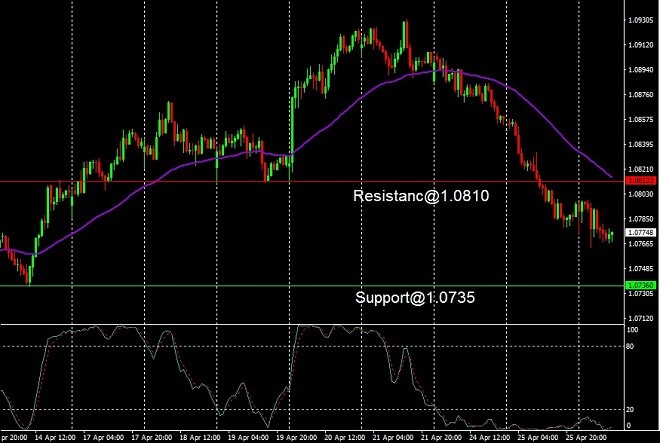
The historical price chart indicates that the AUD/NZD pair is declining after facing resistance at 1.0810. The next major support is anticipated at 1.0735. Additionally, the currency pair is trading below its 50-day moving average, while the stochastic indicator is in the bearish zone. Therefore, we anticipate the AUD/NZD pair to remain in a downtrend in the days ahead.
Disclaimer: Any financial trading analysis offered here is our opinion and is not intended as advice or direction for investors. We cannot guarantee the success of any trades made as a consequence of this article, and we encourage traders to incorporate a strong money management strategy to limit losses when they enter the markets. Please use this article as part of your own research before formulating strategies prior to trading.