
The Eurodollar declined against the greenback to hit a more than 17-month low on the first day of the trading week after the Eurostat reported worsening consumer confidence index in the Eurozone. The US existing home sales hit a nine-month high and surpassed estimates. There were no other major economic releases yesterday. Overall, the EUR/USD pair recorded an unabated decline from 1.1290 to 1.1227 in the last 24 hours.
As per data published by Eurostat, the Eurozone consumer confidence index worsened to -6.80 in November, from -4.8 in the prior month. Economists did not anticipate any change in the consumer confidence index.
In the US session, the National Association of Realtors stated that total existing home sales, including single-family homes, townhomes, condominiums, and co-ops, increased 0.80% m-o-m to 6.34 million units in October, from 6.29 million units in the earlier month and pleased economists who were anticipating a decline in the existing home sales to 6.20 million units. On a y-o-y basis, sales dropped 5.80% in October 2021 (6.73 million units in October 2020).
Commenting on the data, Lawrence Yun, NAR’s chief economist, said, “Home sales remain resilient, despite low inventory and increasing affordability challenges.”
The EUR/USD pair began a fresh week in a weak manner as the European economies face the possibility of another ‘lockdown’ winter. Europe’s common currency recorded its biggest losses since the start of June and days that followed the moves by the US Fed, signaling a systematic removal of the monetary stimulus granted to the economy since the outbreak of the pandemic.
The EUR/USD pair recorded a low of 1.1249 last week as the US dollar marched forward against its major rivals, excluding the pound and the Chinese Renminbi. Notably, the euro posted a decline against all the major rivals, devoid of its risk susceptible zonal counterparts.
The Eurodollar’s depreciation gained momentum after the Netherlands and Austria revealed their plans to reintroduce restrictions to contain COVID-19 infections. Even German officials started contemplating the reintroduction of prohibitions in several parts of the country in the days ahead.
The likelihood of another round of shutdowns has clouded the Eurozone economic rebound and will probably weigh on the analyst’s and investors’ anticipations of policy normalization by the European Central Bank (ECB). The euro’s trend will likely be decided by the extent of restrictions imposed on the continent.
In recent times, financial market participants have become increasingly confident of a rate hike by the US Fed in June or July 2022. Notably, the overnight-indexed-swap rate signals a hike in the benchmark interest rate twice before the end of next year.
The weak Eurozone economic data coupled with a rise in COVID-19 cases is expected to keep the Eurodollar weak against the greenback in the days ahead.
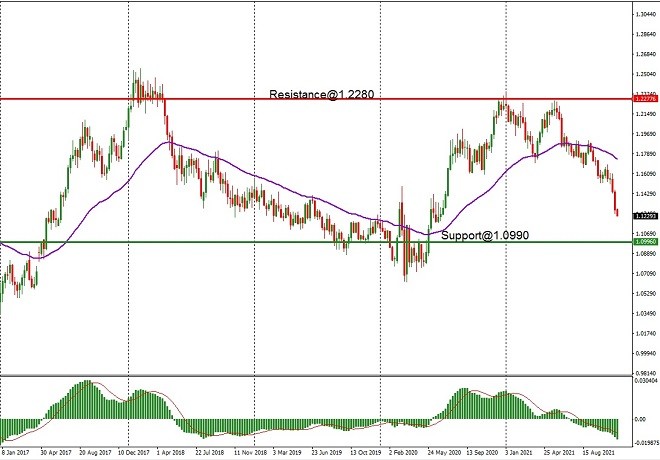
The historical price chart indicates that the EUR/USD pair is declining after facing resistance at 1.2280. The next support is anticipated only near 1.0990. Additionally, the currency pair is trading below its 50-day moving average, while the MACD indicator has a negative reading. Therefore, we are anticipating the currency pair to remain in a downtrend in the short term.
Disclaimer: Any financial trading analysis offered here is our opinion and is not intended as advice or direction for investors. We cannot guarantee the success of any trades made as a consequence of this article, and we encourage traders to incorporate a strong money management strategy to limit losses when they enter the markets. Please use this article as part of your own research before formulating strategies prior to trading.