
The pound rose against the kiwi dollar yesterday despite the release of robust retail sales data from New Zealand. The rebound in dairy prices in the latest Global Dairy Auction did not have much of an impact on the New Zealand dollar.
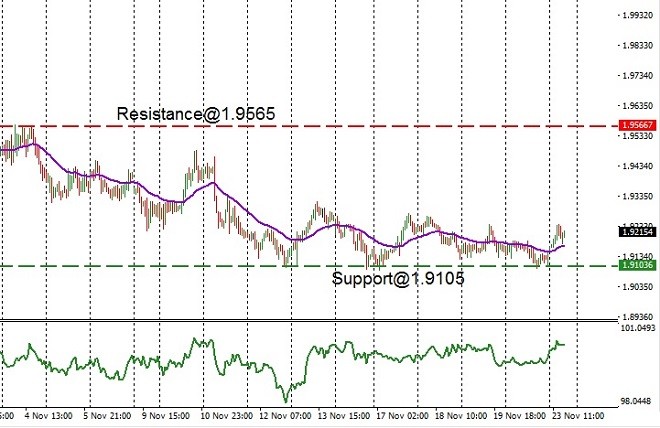
The pound, on the contrary, rose despite the release of mixed economic data. The positive news about the COVID-19 vaccine and optimism about the post-Brexit trade deal continues to spur the pound against its peers. In the past 24 hours, the GBP/NZD pair rose from a low of 1.9105 to a high of 1.9240.
According to Statistics New Zealand, retail sales increased 28% q-o-q in the September quarter, following a contraction of 14.8% in the June quarter, and higher than the 20% growth anticipated by economists.
Barring flammable goods, core retail sales increased 24.1% q-o-q in the September quarter, following a contraction of 13.7% in the second quarter.
In value terms, retail sales increased 7.4% y-o-y to $1.80 billion in the September quarter. Correspondingly, the total volume of retail sales grew by 8.3%. Of the 16 regions, 15 of them showed higher sales values. 12 of the 15 sectors had greater sales values in the September quarter than similar quarters of 2019.
Motor vehicle and parts retail sales increased 13% to $454 million. Likewise, supermarket and grocery store sales rose 8.4% to $429 million. Also, hardware, building, and garden supplies grew 16% to $352 million. While department store sales increased 12% to $147 million, recreational goods retailing rose 20% to $115 million.
In the latest Global Dairy Trade auction conducted on 17th November, the average price of dairy products rebounded by 1.8% to $3,157 per ton, following a 2% drop in the earlier auction (3rd November). Whole Milk Powder prices also increased by 1.8% to $3,037 per ton. Skim Milk Powder prices increased 2.5% to $2,799 per ton, following a decline of 4.4% in the previous month.
Fonterra CEO Miles Hurrell sounded cautiously optimistic about the latest auction: “It picks up the loses that we incurred in the last event.”
In the UK, flash data provided by IHS Markit / CIPS (Chartered Institute of Procurement & Supply) indicated that manufacturing PMI (purchasing managers’ index) increased to three months high of 55.20 in November, from the final estimate of 53.70 in the earlier month.
Economists had anticipated a decline in the flash manufacturing PMI to 50.50. Similarly, the flash manufacturing output index reached a two-month high of 56.30 in November, from 55.80 (final reading) in October.
However, flash services PMI declined to six month low of 45.80 in November, from 51.40 (final estimate) in the earlier month. The consensus estimate called for a reading of 43.20. The reported reading fell below the level of 50 for the first time since June. A reading below 50 indicates contraction and vice-versa.
Overall, the flash composite output index recorded a 6-month low of 47.40 in November, from 52.10 (final data) in October. The figure reflects the steepest decline since May. Notably, the gap between the service sector’s poor performance (45.80) and the robust performance of the manufacturing sector (56.30) was the widest since the statistical organizations started gathering data 25 years back.
The gap mirrors the jolt caused on business activity by the second lockdown in England and stringent Covid-19 prohibitions across the UK.
After four months of expansion, business activity fell across the UK private sector. The quickest drop led to the decline in service sector output against the backdrop of temporary shutdowns in the leisure and hospitality sectors.
On the contrary, manufacturing production improved at a substantial rate during November, and the rate of growth expedited since the earlier month. However, the recent manufacturing PMI survey reflected big delays in supplier delivery times against the backdrop of severe postponements at the UK ports, along with a strong level of inventory rise as manufacturers opted to gather crucial inputs before the end of the Brexit transition phase on 31st December 2020.
As we advance, private sector enterprises are optimistic about business activity in the forthcoming 12 months. The level of optimism increased since October and stood at the most substantial level since March 2015.
Commenting on the data, Chris Williamson, Chief Business Economist at IHS Markit, said: “A double-dip is indicated by the November survey data, with lockdown measures once again causing business activity to collapse across large swathes of the economy. As expected, hospitality businesses have been the hardest hit, with hotels, bars, restaurants, and other consumer-facing service providers reporting the steepest downturns.”
Group Director at CIPS, Duncan Brock, stated: “[….] news of potential vaccines bringing a return to normality lifted the mood with a big rise in optimism to its highest since March 2015. But in the meantime, with service businesses still shedding jobs at a head-spinning rate, the New Year will be difficult as another recession waits on the doorstep.”
The positive news about the COVID-19 vaccine and hopes for a post-Brexit trade deal leads the pound rather than economic data. Therefore, despite the UK’s mixed economic data, the GBP/NZD pair is expected to remain range-bound with a slight bullish bias.
The historical price chart indicates reliable support for the GBP/NZD pair at 1.9105. The next resistance is predicted near 1.9565. Additionally, the momentum indicator is also rising. Therefore, we are expecting the currency pair to rally in the days ahead.
Disclaimer: Any financial trading analysis offered here is our opinion and is not intended as advice or direction for investors. We cannot guarantee the success of any trades made as a consequence of this article, and we encourage traders to incorporate a strong money management strategy to limit losses when they enter the markets. Please use this article as part of your own research before formulating strategies prior to trading.