The euro strengthened against the yen yesterday despite the release of lower-than-anticipated German wholesale price index data for December. Notably, Japan’s producer price index data for December was also better than expected. Still, the euro strengthened against the yen on expectations of a further rate hike by the ECB (European Central Bank) and a decline in US bond yields. Overall, the EUR/JPY pair rallied from a low of 138.05 to a high of 139.27 in the past 24 hours.
According to the data published by the Bank of Japan, the country’s PPI (producer price index) rose by 10.20% y-o-y in December, following a 9.70% rise in the prior month and exceeding forecasts of a 9.50% increase. The reported figure is the highest in three months.
The main reason for the increase was a weak yen which propelled the prices of imported raw materials. Electric, power, gas, and water recorded an increase of 52.30% y-o-y in December. While minerals grew by 33.90%, iron and steel rose by 20.90%. Pulp, paper, and related products posted a rise of 13.30%. Metal products jumped 12.80%.
Furthermore, producer prices inched up 0.50% m-o-m in December 2022, following a 0.80% rise in November and surpassing market expectations for a 0.30% growth.
According to Japan Machine Tool Builders Association (JMTBA), the prelim machine tool orders rose by 1% y-o-y in December to ¥140.58 billion, following a decline of 7.70% in the prior month. The rebound reflects a demand recovery in December.
Overseas orders surged 11.60% y-o-y in December to ¥98.26 billion. This is the first increase in three months. Domestic orders slumped 17.30% to ¥42.32 billion in the same period. Notably, it is the fourth successive decline. Overall, on a y-o-y basis, machine tool orders had been increasing for 23 successive months through September.
According to Destatis, the German wholesale price index fell by 1.60% m-o-m in December, following a decline of 0.90% in the prior month and worse than forecasts of a 0.30% decrease.
On a y-o-y basis, the wholesale price index surged 12.80% in December 2022. Furthermore, Germany’s wholesale selling prices jumped 18.80% in 2022, compared with the previous year.
Mineral oil products surged 22.80% m-o-m in December. On a y-o-y basis, solid fuels jumped 82.30% while living animals increased 47.60%.
Despite the weak economic data, the euro’s trend was guided by the recent ECB (European Central Bank) council members’ support for a rate hike. Also, the steep fall in US bond yields (two-year maturity) bolstered the euro against the dollar and other rivals.
On Monday, the euro rallied against the greenback to hit its highest level since April 2021. Going forward, the trend this week could be decided by ECB Chief Christine Lagarde’s speech and a policy decision by the Bank of Japan.
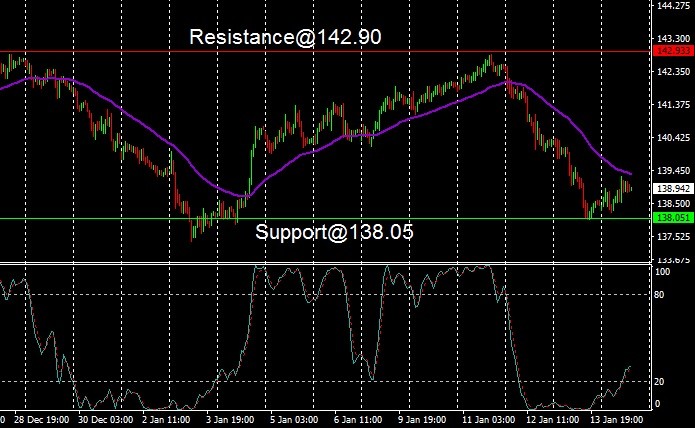
The historical price chart indicates that the EUR/JPY pair is rising after testing the support at 138.05. The next resistance is anticipated only near 142.90. Additionally, the stochastic indicator is rising toward the bullish zone. Therefore, we anticipate the EUR/JPY pair to remain in an uptrend in the days ahead. It is prudent to open a long position after the currency pair breaks above the 50-period (based on the time chart used for trading) moving average.
Disclaimer: Any financial trading analysis offered here is our opinion and is not intended as advice or direction for investors. We cannot guarantee the success of any trades made as a consequence of this article, and we encourage traders to incorporate a strong money management strategy to limit losses when they enter the markets. Please use this article as part of your own research before formulating strategies prior to trading.