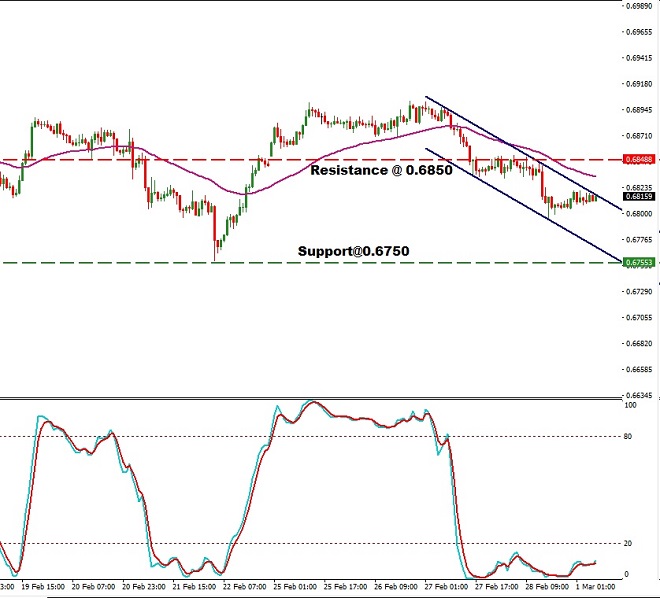
The New Zealand dollar tumbled against the greenback after the US Bureau of Economic Analysis published a lesser-than-anticipated decline in the GDP growth rate. The hopes of the New Zealand dollar’s recovery faded after Statistics New Zealand today reported a drop in terms of trade in the fourth-quarter of 2018. The decline happened despite reports of a substantial rise in building permits. From a high of 0.6850, the NZD/USD pair recorded a low of 0.6795. The currency pair is now trading near 0.6810.
New Zealand dollar dips despite posting strong building permits data
Data from the US Commerce Department indicated that the country’s economic growth declined in 4Q 2018, even though the rate of growth still surpassed economists’ estimates.
The announcement further stated that real GDP grew by 2.6% in the fourth quarter, compared with a 3.4% increase in the earlier quarter. Economists had anticipated GDP to grow by 2.3%.
The Labor Department data also showed that initial jobless claims surged more than anticipated in the week ended February 23rd. The report stated initial claims of unemployment benefits jumped to 225,000, up 8,000 from the earlier week’s revised level of 217,000. Economists had anticipated jobless claims to increase to 220,000, from 216,000 reported in the prior week.
The unexpectedly strong GDP growth rate triggered the NZD/USD pair selloff.
This morning Statistics New Zealand reported a steady rise in building permits. On a seasonally adjusted basis, the agency stated that 2,496 building permits had been issued in January – up 17% on a m-o-m basis. In December, building permits increased by 5.4%.
For the year ended January 2019, the number of new building permits approved was 33,576, up 7.4% from January 2018. The agency also revealed that the annual value of non-residential building work approved was NZ$7.1 billion, an increase of 7% from January last year.
However, the positive data hardly had any impact on the Kiwi dollar as the terms of trade data turned the mood bearish once again. Statistics New Zealand stated that merchandise terms of trade declined a seasonally adjusted 3% in the final quarter of 2018. The reported figure missed expectations for a fall of 1%, following the 0.1% decline in the previous three months.
Export prices for merchandise dropped by 1.7%, while import prices increased by 1.4%. Export volumes increased by 0.8%, and the import volumes grew 0.2%. Furthermore, the value of goods exported declined by 1.3%, while the import values rose 2.7%. Notably, the services terms of trade increased 4.1%. Specifically, services export prices grew by 2.3%, while import prices declined by 1.7%.
The currency pair has broken the support at 0.6850. The next support exists at 0.6750. Additionally, the stochastic oscillator is in the bearish region. The currency pair is also trading below its 50-day moving average. As a result, we can anticipate the NZD/USD pair to remain in a downtrend.
Disclaimer: Any financial trading analysis offered here is our opinion and is not intended as advice or direction for investors. We cannot guarantee the success of any trades made as a consequence of this article, and we encourage traders to incorporate a strong money management strategy to limit losses when they enter the markets. Please use this article as part of your own research before formulating strategies prior to trading.