

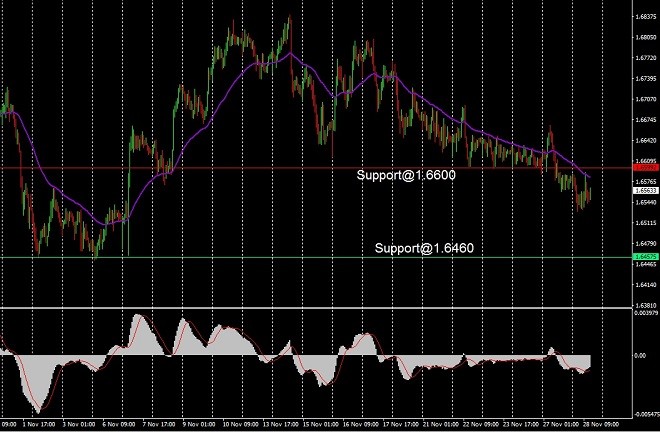
The Aussie remained range-bound against the euro yesterday following the release of weaker economic data from both Australia and Germany. While Australian retail sales unexpectedly declined in October, the German consumer climate index for December remained weak. Overall, the EUR/GBP pair traded between 1.6540 and 1.6600 in the past 24 hours.
According to the Australian Bureau of Statistics, the country’s retail sales inched down by 0.20% m-o-m in October following a 0.90% rise in the previous month and missed forecasts of a 0.10% growth.
On a y-o-y basis, the country’s retail sales grew by 1.20% in October 2023.
Food retailing inched up 0.5% (or A$67.10 million) in October. This was more than negated by a 0.60% (or A$37.20 million) decline in household goods retailing. Likewise, clothing, footwear, and personal accessory retailing inched down by 1% (or A$30.60 million) in October. Department stores fell by 0.60% (or A$11.70 million). Additionally, cafes, restaurants, and takeaway food services posted a decrease of 0.40% (or A$20.40 million) in October.
The German GfK consumer climate index, published jointly by GfK and its founder, Nuremberg Institute for Market Decisions (NIM), inched up to -27.80 for December from -28.30 in November. Economists had anticipated a reading of -28.20.
German consumer sentiment remained almost unchanged in November compared with the previous month. Also, economic forecasts stood almost unchanged in November. The inclination to buy has increased slightly, while income anticipations have recorded a slight decrease.
The inclination to save fell to 5.30 points in November from 8.50 points in October. This was the main reason for the slight growth in consumer sentiment.
Reflecting high inflation, the gauge of income expectations declined to -16.70 points in November from -15.30 points in October. Correspondingly, the index reflecting the inclination to purchase remains at a low level of -15 points for November, despite a 1.30-point increase from October.
Overall, the gauge of economic expectations of German consumers stood almost unaltered for the upcoming month. After a small rise of 0.10 points, the index reading now stands at -2.30 points. However, it is 15.60 points above the level recorded in November 2022.
The weak economic data from both countries is expected to keep the EUR/AUD pair range-bound in the near term.
The historical price chart indicates that the EUR/AUD pair is declining after facing resistance at 1.6600. The next major support is anticipated only near 1.6460. Additionally, the currency pair is trading below its 50-day moving average, while the MACD indicator is showing a negative reading. Therefore, we anticipate the EUR/AUD pair to remain in a downtrend in the near term.
Disclaimer: Any financial trading analysis offered here is our opinion and is not intended as advice or direction for investors. We cannot guarantee the success of any trades made as a consequence of this article, and we encourage traders to incorporate a strong money management strategy to limit losses when they enter the markets. Please use this article as part of your own research before formulating strategies prior to trading.


