The Eurodollar fell against the yen yesterday after the release of worse-than-anticipated contraction of German industrial activity and continuing pessimism among investors about the Eurozone economy, despite an improvement from the previous reading. Notably, during the Asian session, the Cabinet Office of Japan reported a contraction of the economy in the first quarter.
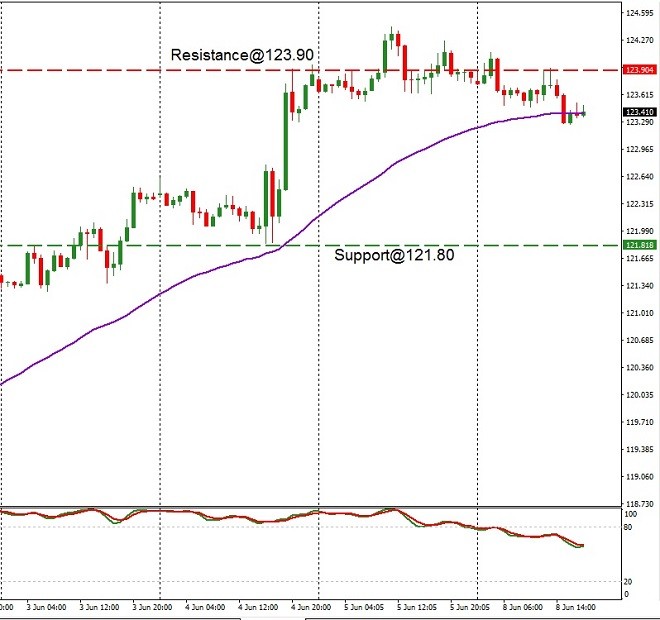
However, it was slightly better than preliminary estimates, enabling the yen to gain ground against the euro. In the past 24 hours, the EUR/JPY pair has fallen from a high of 123.90 to a low of 123.35.
According to Japan’s Cabinet Office, the country’s GDP shrank by 0.6% q-o-q in the first quarter of 2020, compared with a preliminary estimate of 0.9% contraction and a notch higher than the 0.5% decline anticipated by economists. The robust capital investment supported the economy, leading to slightly lesser contraction than the preliminary estimate.
On an annualized basis, the economy contracted by 2.2%, compared with the final quarter of 2019, and better than the preliminary estimate of a 3.4% contraction. Economists had anticipated an upward revision to -2.1%. Even though the final figure is better than the initial estimate, it still indicates that the country’s economy had contracted for two consecutive quarters. Economists anticipate a deeper contract in the second quarter.
Capital investment made by non-financial Japanese companies increased 4.3% y-o-y in the first quarter, followed by a 3.5% decline in the earlier quarter. It was the first decrease in 13 quarters. Capital expenditure, barring software, increased 3.5% y-o-y in the first quarter, after declining 5% in 4Q 2019.
The Cabinet Office also reported that the final GDP price index rose 0.9% y-o-y in the first quarter, unchanged from the initial estimate and in-line with economists’ estimates.
According to the Japanese Ministry of Finance, the current account surplus fell to ¥0.25 trillion in April, from ¥0.94 trillion in the earlier month. The reported figure was worse than the ¥0.33 trillion surplus anticipated by economists.
In a separate news release, the Cabinet Office reported an improvement in the Economy Watchers Sentiment index to 15.50 in May, from 7.90 in April and better than the 12.60 reading anticipated by analysts. Economy Watchers is a term used while surveying taxi drivers, restaurant staff, and hotel workers as they can precisely provide an idea of consumer sentiment and retail trends.
In Europe, data published by Destatis indicated a contraction in the German industrial production by 17.9% in April, following an 8.9% contraction the prior month. Economists had anticipated the industrial output to contract by 16%. The calendar-adjusted y-o-y decline was 25.3%, representing the most significant drop since the data began publishing in 1991. Notably, in April 2020, production in industry, barring energy and construction decreased by 22.1%.
The Sentix investor confidence reading improved to -24.80 in June, from -41.80 in the earlier month. Economists had anticipated improvement in Sentix investor confidence to 22.0. Even though the reading indicates that investors are expecting a rebound in economic activity, the reading reflects overall pessimism.
The weak economic data from Japan and Europe are expected to keep the EUR/JPY pair range-bound with a slight bearish bias.
Technically, the EUR/JPY pair is declining after facing resistance at 123.90. The next support is anticipated only near 121.80. The stochastic oscillator is also making new lows. Additionally, the currency pair has also closed below its 50-day moving average. Therefore, we are anticipating the EUR/JPY pair to decline in the short-term.
Disclaimer: Any financial trading analysis offered here is our opinion and is not intended as advice or direction for investors. We cannot guarantee the success of any trades made as a consequence of this article, and we encourage traders to incorporate a strong money management strategy to limit losses when they enter the markets. Please use this article as part of your own research before formulating strategies prior to trading.