The euro remained range-bound against the yen yesterday following the release of impressive German wholesale prices and Italian unemployment data. Earlier in the Asian session, the Cabinet Office of Japan reported overwhelmingly positive core machinery orders data for October. Overall, the EUR/JPY traded in a small range of between 128.02 and 128.45 in the last 24 hours.
According to the Cabinet Office of Japan, the country’s core machinery orders, reflecting the likely capital spending in the upcoming six to nine months, rose by 3.80% m-o-m in October, following no change in September, and more than 2.10% expansion anticipated by economists polled by Reuters. The reported figure reflects an increase in core machinery orders for the only time in three months as service sector companies boosted investment against the backdrop of low COVID-19 infections.
Core orders from service-sector firms, devoid of ships and electrical utilities, increased 16.50% m-o-m in October, driven by a 170.10% surge in transport and postal services due to massive orders recorded by the railroad vehicles sector.
In the meantime, orders from manufacturers fell by 15.40% m-o-m, as declining demand from chemical companies negated growth posted by semi-conductor making machinery and production machinery firms.
On a y-o-y basis, core orders grew by 2.90% in October, missing the 4% increase anticipated by economists. Capital outlay of companies declined in Q3 2021 due to the worldwide resurgence of COVID-19 infections, which specifically affected car manufacturers who are dependent on spare parts supplies from Asian factories.
The third-largest economy is on course to record a robust rebound in Q3 2021 after a higher than anticipated contraction in July-September, even though the outlook is presently gloomed by uncertainties over the latest omicron strain of coronavirus.
Even though logistics issues eased, capital expenditure and production outlook stood sluggish.
A closely tracked central bank survey indicated that the country’s service sector sentiment improved to a two-year high, but the activities of manufacturers have stagnated as increasing raw material prices seems to be affecting the economic rebound from the COVID-19 pandemic.
The Tankan manufacturing index remained at 18 in the fourth quarter of this year, unaltered from the earlier quarter, but a notch lower than the consensus estimate of 19. Increasing costs and auto output issues weighed on industries such as machinery, non-ferrous metals, and chemicals.
Large enterprises anticipate the situation to worsen as a rise in fuel prices and a wobbly yen lift import costs, strengthening the argument that Japan will continue with huge fiscal and monetary assistance to support a delicate economic rebound.
Interestingly, the Tankan non-manufacturing index surged to 9 at the end of the final quarter of 2021, reflecting the sixth consecutive rise, an increase from 2 in the September quarter and surpassing the market outlook for a reading of 5.
The index recorded the highest level since December 2019, aided by the lifting of emergency prohibitions enforced to contain the COVID-19 pandemic.
Notably, companies anticipate inflation to reach 1.10% in the year ahead, representing the highest level since September 2015, as per the Tankan survey.
Large enterprises intend to boost capital spending by 9.30% in the year ended March 2022, missing the economists’ forecasts calling for a 9.80% gain, but rebounding from an 8.30% decline in the earlier year.
Regarding the economic rebound, the country is behind other major economies. Specifically, Japan’s GDP has contracted by 3.60% (annualized) in the September quarter due to poor consumption and output declined by a surge in infections and supply limitations.
According to the German statistical organization Destatis, the country’s wholesale prices grew by 1.30% m-o-m in November, following an increase of 1.60% in the prior month and in line with economists’ estimates.
On a y-o-y basis, wholesale prices increased 16.60% in November 2021. The reported figure reflects the highest annual growth since 1962, when Destatis started calculating the data. The sharp rise in wholesale prices was led by an increase in the price of raw materials and intermediate products. Specifically, mineral oil products posted a 62.40% y-o-y jump in wholesale prices. Likewise, residual materials recorded an increase of 77.40%. Ores, metals, and semi-finished metal products gained 60.30%. Also, raw and sawn timber reported a growth of 41.10%. Grain, raw tobacco, seeds, and animal feed posted a rise of 30.30%.
According to the data published by the Italian National Institute of Statistics, the country’s unemployment rate nudged downwards to 9.20% in the quarter ending September 2021, from 9.80% in the June quarter and better than the 9.40% unemployment rate anticipated by economists.
On a y-o-y basis, the number of employed people increased by 505,000 in September 2021 quarter.
Overall, 22.919 million people remained employed at the end of September quarter, up 121,000 from the prior quarter. The employment rate stood at 58.40%.
The count of individuals working on temporary contracts rose by 2.30% q-o-q in September quarter. As a whole, the temporary workers count increased to over 3 million.
The solid economic data from both Japan and Europe are expected to keep the EUR/JPY pair range-bound with a slight bearish bias in the near term.
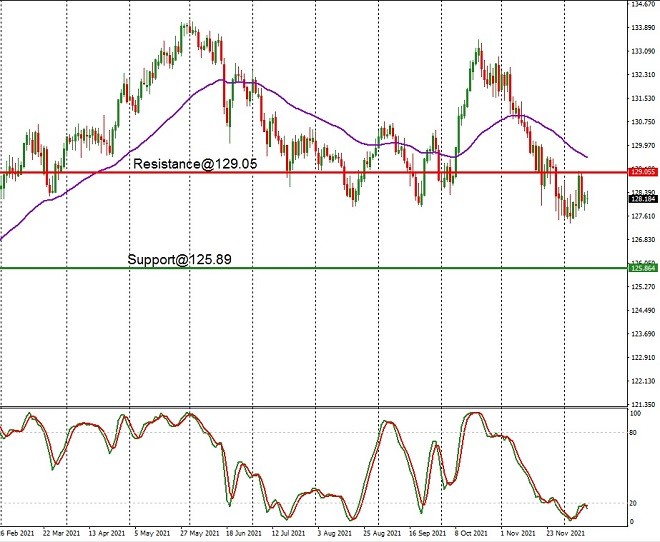
The historical price chart indicates that the EUR/JPY pair is facing resistance at 129.05. The next support is anticipated only near 125.89. Additionally, the currency pair is trading below its 50-day moving average, while the stochastics indicator is in the bearish zone. Therefore, we are anticipating the currency pair to remain in a downtrend in the short term.
Disclaimer: Any financial trading analysis offered here is our opinion and is not intended as advice or direction for investors. We cannot guarantee the success of any trades made as a consequence of this article, and we encourage traders to incorporate a strong money management strategy to limit losses when they enter the markets. Please use this article as part of your own research before formulating strategies prior to trading.