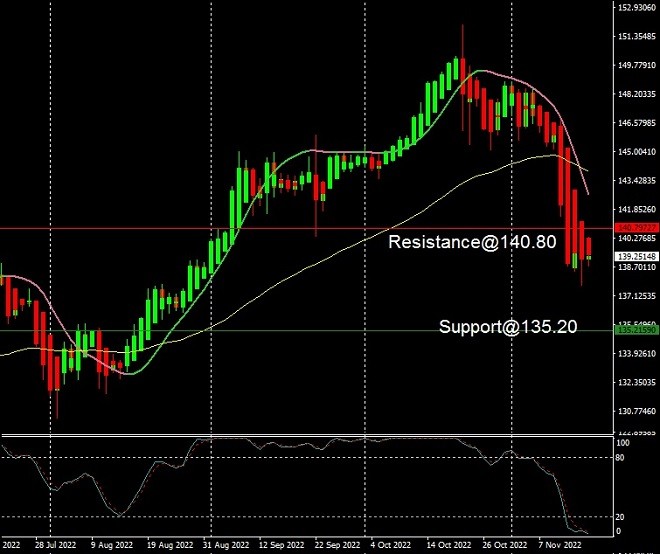
The greenback remained range-bound against the yen yesterday following the release of weak economic data from both the US and Japan. While the US capacity utilization rate and industrial production data for October missed estimates, Japan’s core machinery orders unexpectedly declined in September. Overall, the USD/JPY pair remained range-bound between 138.70 and 140.30 in the past 24 hours.
According to Japan’s Cabinet Office, the country’s core machinery orders fell by 4.60% m-o-m in September, following a six-month low reading of a 5.80% decline in August, and missing forecasts of 0.60% growth.
Manufacturing orders decreased by 8.50% m-o-m in September. Non-ferrous metals recorded a low of 82.40%. Other transport equipment posted a decline of 39.80%. Iron & steel reported a fall of 31.20%. In the meantime, non-manufacturing orders grew by 4.40% in September. Real estate surged by 42.70% while information services posted an increase of 23.20%. Telecommunications recorded a growth of 20.90%.
On a y-o-y basis, machinery orders increased by 2.90% in September 2022, easing from a 9.70% rise in August.
According to the data published by the Ministry of Economy, Trade, and Industry (METI), Japan’s tertiary industry activity fell by 0.40% m-o-m in September, following a rise of 0.70% in August. Economists had anticipated a 0.60% growth in tertiary industry activity. Correspondingly, the index stood at 99.50 in September.
Also, the index representing broad-ranging personal services grew by 1.30% m-o-m in September to 99.30. Likewise, the index representing broad-ranging business services fell by 1.30% m-o-m in September to 99.70.
According to the US Census Bureau, the country’s retail sales grew by 1.30% m-o-m in October to $694.50 billion, after remaining unaltered in the prior month, and a few notches higher than forecasts of a 1% increase. The reported reading reflects the highest growth in eight months.
On a y-o-y basis, US retail sales surged 8.30% in October 2022. Also, aggregate sales for the August-October 2022 period stood 8.90% higher than similar periods last year.
Food services and drinking places posted a growth of 1.60% in October. Also, food and beverage stores recorded a rise of 1.40%. Non-store retailers reported an increase of 1.20%. Both furniture and building materials recorded a growth of 1.10%. On the contrary, electronics posted a decline of 0.3%. Similarly, sporting goods, hobbies, musicals, and books recorded a drop of 0.30%.
Motor vehicle dealers recorded a sales increase of 1.30% in October as distribution chain limitations are easing across the globe. Without gasoline and autos, retail sales grew by 0.90%.
According to the data published by the US Federal Reserve, the country’s capacity utilization rate inched down to 79.90% in October from 80.30% in the prior month, and disappointed economists who were expecting an increase in the capacity utilization rate to 80.40%. The reported rate, however, is 0.30% higher than the long-term (around 50 years) average.
The Federal Reserve also stated that industrial production contracted 0.10% m-o-m in October, following an increase of 0.10% (downwardly revised from 0.40%) in the prior month and missing forecasts of 0.10% growth. The corresponding index stood at 104.70 in October 2022, reflecting a 3.30% gain from a similar period last year.
Also, the index for mining fell by 0.40% in October, while the index for utilities declined by 1.50% in the same period.
The weak economic data from both countries and the anticipation of a slower rate hike by the Fed are expected to keep the USD/JPY pair range-bound with a slight bearish bias in the near term.
Technically, the USD/JPY pair is declining after facing resistance at 140.80. The next major support is anticipated only near 135.20. Additionally, the currency pair is trading below its 50-day moving average while the stochastic indicator is in the bearish zone. Therefore, we anticipate the USD/JPY pair to remain in a downtrend in the days ahead.
Disclaimer: Any financial trading analysis offered here is our opinion and is not intended as advice or direction for investors. We cannot guarantee the success of any trades made as a consequence of this article, and we encourage traders to incorporate a strong money management strategy to limit losses when they enter the markets. Please use this article as part of your own research before formulating strategies prior to trading.