The Japanese yen declined against the Eurodollar in the Asian session on the first day of the trading week subsequent to the report of lower than anticipated producer price index data for August. However, the yen was able to quickly recover the lost ground following the release of weak German wholesale price index data in the European session.
The Italian unemployment rate for the second quarter was surprisingly better than the expectations of the market. However, the yen managed to hold its ground. Overall, the EUR/JPY pair traded in a narrow range of 129.58 and 129.85 in the last 24 hours.
According to the data published by the Bank of Japan, the producer price index or the corporate goods price index (CGPI), reflecting the price companies charge one another for the goods and services offered, increased 5.50% y-o-y in August, following a 5.60% rise in the previous month and lower than the 5.70% median estimate of economists.
The reported figure represents the sixth consecutive month of growth. Notably, the July reading reflects the quickest rate of rising since September 2008. The index, currently at 105.80, also mirrors the highest level since 1982, when the country’s economy was roaring primarily due to asset inflation.
The country’s wholesale inflation fluctuated around a 13-year high in August as raw material imports rose on robust worldwide demand. However, companies may be inclined to implement a small price hike considering the revival of the COVID-19 pandemic that has started weighing on consumer demand. Chemical, steel, and wood products prices increased, reflecting strong demand for the products across the globe.
Highlighting the steep cost pressure faced by the Japanese companies, the yen-based import process rose by a record 29.20% y-o-y in August. Notably, core consumer prices declined 0.2% y-o-y in July, reflecting the 12th month of decrease in a row and staying far away from the 2% target of the Bank of Japan.
According to the data published by Destatis, the German wholesale price index increased 0.50% m-o-m in August, following a rise of 1.10% in the previous month, but missed the 0.80% growth anticipated by economists.
On a y-o-y basis, the selling prices in wholesale trade increased 12.30% in August 2021, reflecting the highest monthly annual pace of change since October 1974, when the prices rose by 13.20% y-o-y due to the oil crisis. In July 2021, the selling prices in wholesale trade increased 11.30% on a y-o-y basis.
According to the Italian National Institute of Statistics (Istat), the country’s unemployment rate declined to 9.80% in the June 2021 quarter, from 10.10% in the prior quarter, and surprised economists who did not anticipate any change in the unemployment rate.
Furthermore, the count of employed people increased 338,000 in the June quarter, compared with the March quarter. On a y-o-y basis, the count of employed people rose by 523,000 in 2Q 2021.
Notably, laborers working under temporary agreements grew by 226,000 and led the overall increase, as per the country’s statistical agency. On the contrary, compared with a similar period in 2019, the employment levels remained lower by 678,000.
On a y-o-y basis, the unemployment rate has declined by 1.70% in the second quarter of 2021.
The weak economic data from Japan and mixed monetary data from Europe are likely to keep the EUR/JPY currency pair range-bound with a minor bullish bias in the short term.
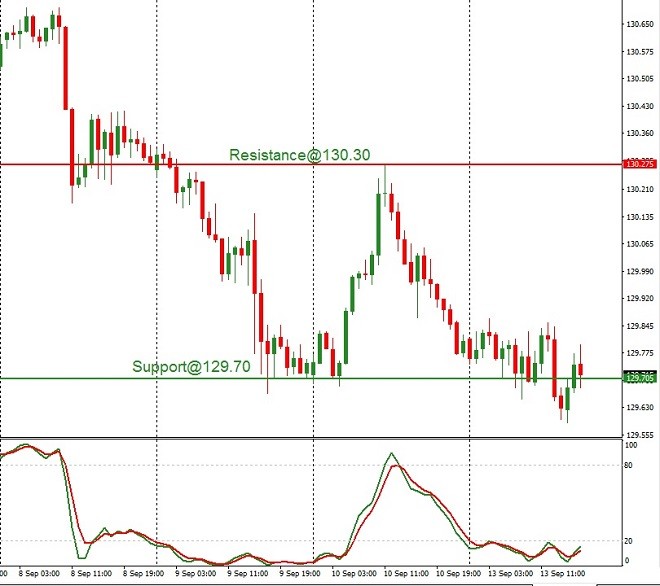
The historical price chart shows that the EUR/JPY pair is rising after testing the support at 129.70. The next resistance is expected only near 130.30. Additionally, the stochastics indicator is in the oversold region. Therefore, we are anticipating the currency pair to rally in the days ahead.
Disclaimer: Any financial trading analysis offered here is our opinion and is not intended as advice or direction for investors. We cannot guarantee the success of any trades made as a consequence of this article, and we encourage traders to incorporate a strong money management strategy to limit losses when they enter the markets. Please use this article as part of your own research before formulating strategies prior to trading.