The Eurodollar remained range-bound against the greenback yesterday following the release of weak economic data from both Europe and the US. While the German trade surplus missed estimates by a significant margin, the US wholesale inventories increased slightly more than anticipated. Overall, the EUR/USD pair remained range-bound between 1.1402 and 1.1450 in the last 24 hours.
According to Destatis, Germany’s trade surplus declined to €6.80 billion in December 2021, from €10.90 billion in the prior month, and disappointed economists who were expecting an increase in the trade surplus to €11.30 billion. In December 2020, Germany had reported a trade surplus of €15.10 billion.
Overall, in 2021, the country recorded a trade surplus of €173.30 billion, reflecting the fifth consecutive year of decline. In 2020, the country had recorded a surplus of €180.40 billion.
Furthermore, the German current account surplus was €23.90 billion in December 2021. This includes €9.40 billion in goods trade surplus, €2.80 billion in services surplus, the primary income of €16.20 billion, and secondary income of negative €4.40 billion. Overall, in 2021, the country had reported a current account surplus of €247.40 billion.
In December 2020, the current account surplus stood at €26.20 billion.
While exports rose by 0.90% m-o-m to €117 billion in December 2021, imports grew by 4.70% to €110 billion during the same period. On a y-o-y basis, exports surged by 15.60%, while imports jumped 27.80% in December 2021.
Overall, in 2021, Germany exports goods worth €1.375 trillion, reflecting a growth of 14% on a y-o-y basis. Imports were €1.202 trillion in 2021, representing an increase of 17.10% from the prior year.
In December 2021, Germany shipped goods worth €63.30 billion to the EU (European Union) member states. During the same period, the country imported goods worth €56.30 billion from the EU.
Exports of goods to countries outside the EU stood at €53.70 billion in December 2021. Likewise, imports from those countries aggregated to €53.60 billion.
Compared with December 2020, exports to the UK fell by 7.60% to €5 billion. Imports from the UK dropped 18.20% to €2.60 billion.
According to Istat (Italian National Institute of Statistics), the country’s industrial production fell by 1% m-o-m in December, following an increase of 2.10% in the prior month and worse than the 0.80% decline anticipated by economists. On a q-o-q basis, industrial production grew by 0.50% in the December 2021 quarter.
On a y-o-y basis, industrial production rose by 4.40% in December 2021.
According to the US Census Bureau, final wholesale inventories rose by 2.20% m-o-m in December, following a 1.70% (upwardly revised from 1.40%) growth in the earlier month and a notch higher than the preliminary estimates of 2.10% increase. Economists had anticipated no change in the preliminary forecasts.
The increase in inventories was led by a 10-year high motor vehicle stocks, instilling optimism that an end to global supply chain issues is nearing.
On a y-o-y basis, wholesale inventories surged 18.50% in December. Inventories are a major portion of gross domestic product. Goods imports reached a historical high in December.
Motor vehicle inventories increased 4.60% m-o-m in December, reflecting the steepest gain since December 2011, following a rise of 3.40% in November. Wholesale inventories, barring autos, rose by 2% in December.
Inventory investment jumped by an annualized rate of $173.50 billion in 4Q 2021, mirroring the second-largest quarterly rise on record. Inventories paved the way for a 4.90% rise in the 6.90% annualized growth in 4Q 2021.
The weak economic data from Europe and the US is expected to keep the EUR/USD pair range-bound in the short term.
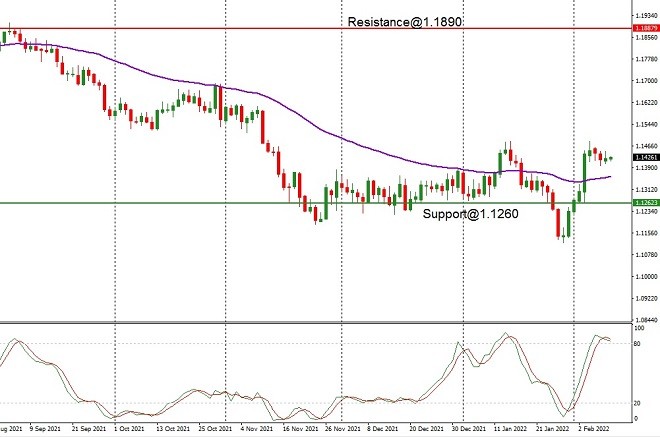
The historical price chart indicates that the EUR/USD pair is rising after testing the support at 1.1260. The next major resistance is anticipated only near 1.1890. Additionally, the currency pair is trading above its 50-day moving average, while the stochastics indicator is in the bullish zone. Therefore, we are anticipating the currency pair to remain in an uptrend in the short term.
Disclaimer: Any financial trading analysis offered here is our opinion and is not intended as advice or direction for investors. We cannot guarantee the success of any trades made as a consequence of this article, and we encourage traders to incorporate a strong money management strategy to limit losses when they enter the markets. Please use this article as part of your own research before formulating strategies prior to trading.