
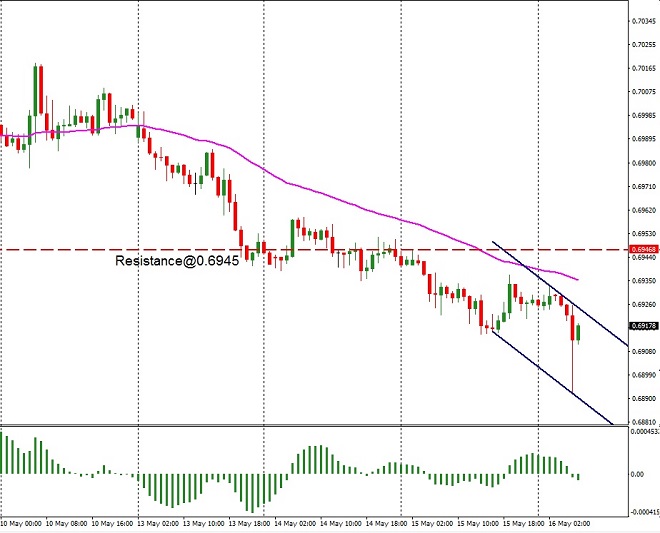
The Australian dollar came under selling pressure yesterday after the wage inflation missed economists’ estimates. Furthermore, the consumer sentiment index recorded soft growth, while the business conditions index declined. The US-China trade-related reports did not do the currency any favors either. From a high of 0.6945, the AUD/USD pair fell to a low of 0.6890 in the past 24 hours.
Weak economic data, US-China trade tensions rattle the Aussie
The Australian Bureau of Statistics stated that the Wage Price Index rose 0.5% q-o-q in the three months ended March, the same as in the previous quarter. Economists had anticipated higher inflation of 0.6%.
Yesterday, the Westpac-Melbourne Institute reported a 0.6% rise in Consumer Sentiment in May. That compares with a 1.9% increase in April. Similarly, the National Australia Bank reported that the business confidence index moved a notch up to 0 from -1 in April. In the same period, the business conditions index fell from +7 to +4.
The negative macroeconomic data triggered the AUD/USD sell-off. The decline was fueled by poor economic news from China and negative developments related to the US-China trade discussions.
Today, the Australian Bureau of Statistics announced that the unemployment rate increased to 5.2% in April, from an upwardly revised 5.1% in the earlier month. Notably, this is the second consecutive month the unemployment rate has inched higher. The unemployment rate stood at 4.9% in February. In addition to the weak economic data, China’s slowdown is also affecting the Aussie.
China’s economy lost momentum in April, highlighting the vulnerability of the second-largest economy of the world, as it gears up for a heightened conflict with the US over trade. Industrial production (5.4% y-o-y in April Vs. 8.5% in March), retail turnover (16 years low of 7.2% Vs. 8.6% anticipated by analysts), and investment slowed down more than forecast by economists.
The public sector industries continue to increase investment, while private businesses cooled down. Furthermore, an increase in manufacturing investment was at its slowest rate as data matched with 2004.
Commenting on the weakness in the economy, Lu Ting, chief China economist at Nomura Holdings Inc. in Hong Kong, said: “The double-dip is confirmed. We expect Beijing to significantly ramp up easing/stimulus measures to stabilize financial markets and bolster growth, despite the more limited policy room than in previous easing cycles.”
Echoing similar thoughts, Bloomberg Analysts said: “The undershoot in April activity shows the Chinese economy had yet to find a sure footing even before the latest escalation in the trade war.”
Regarding the US-China trade talks, former Trump advisor Steve Bannon has stated that President Donald Trump will not offer concessions to China in the trade war.
The former White House chief strategist further stated that: “China has been running an economic war against the industrial democracies for now 20 years.”
With both parties sticking to their view, the ongoing trade discussions may not be resolved as quickly as earlier expected. The Aussie may remain volatile until the trade issue is resolved.
The AUD/USD pair has broken the level of 0.6945, which acts as major support. Additionally, the oscillator of the moving average also has a negative reading. As a result, we can expect the AUD/USD pair to move down in the short-term.
Disclaimer: Any financial trading analysis offered here is our opinion and is not intended as advice or direction for investors. We cannot guarantee the success of any trades made as a consequence of this article, and we encourage traders to incorporate a strong money management strategy to limit losses when they enter the markets. Please use this article as part of your own research before formulating strategies prior to trading.