
Video Source: The Market View on YouTube
The euro fell against the yen yesterday, despite the release of weak economic data from both Japan and Europe. While Japan’s industrial production and housing starts data for July missed estimates, Germany’s retail sales unexpectedly declined in the same period. This triggered another euro sell-off. Overall, the EUR/JPY pair declined from a high of 159.75 to a low of 158.40 in the past 24 hours.
According to the preliminary data published by Japan’s Ministry of Economy, Trade, and Industry (METI), the country’s industrial production fell by 2% m-o-m in July, following a 2.40% increase in the previous month and worse than forecasts of a 1.20% decline. The reported figure reflects the third decline this year. The contraction was led by a 4.80% decrease in production machinery. Likewise, the production of electronic parts and devices fell by 5.10%m-o-m in July. Electrical machinery, and information and communication machinery declined by 2.90%. On a y-o-y basis, industrial output contracted by 2.50% m-o-m in July, following a no-change reading in June.
In separate news, METI stated that Japan’s retail sales increased 6.80% y-o-y in July, following a 5.60% rise in the previous month and greater than forecasts of 5.50% growth. The reported figure reflects the 17th successive month of growth in retail trade, with consumption continuing to rise following the decline triggered by the pandemic.
Automobile retailers recorded an increase of 8.10%, while food retailers posted a growth of 8%. Pharmaceuticals and cosmetics posted a growth of 6.80%. Likewise, miscellaneous product retailers and machine equipment retailers reported an increase of 6.30% and 4.30%, respectively. Retail sales at non-store retailers grew by 3.60%. Similarly, textile, apparel, and accessory retailers recorded a 3% increase in retail sales.
Furthermore, retail sales rebounded with a growth of 2.10% in July, following a 0.40% decline in June.
According to Japan’s Ministry of Land, Infrastructure, Transport, and Tourism (MILT), the country’s housing starts declined 6.70% y-o-y in July, following a 4.80% decline in the previous month and worse than forecasts of a 1.30% decrease. The reported figure reflects the fifth decline in fresh construction starts since the beginning of this year.
According to the data published by Destatis, German retail sales (real) fell by 0.80% m-o-m in July following a similar decline in the previous month, which disappointed economists who were forecasting a growth of 0.30%. On a y-o-y basis, German retail sales fell by 2.20% in July 2023.
Retail sales of groceries rose by 2%m-o-m in July. On the contrary, on a y-o-y basis, food retail sales declined by 1.80% in July 2023. Additionally, retail sales of non-food items grew by 0.20% m-o-m in July 2023 but stood 1.90% lower than in July 2022. Likewise, textiles, clothing, footwear, and leather goods sales declined 3.30% y-o-y in July 2023 but rose by 4.70% from July 2022.
The Eurozone annual consumer price inflation was 5.30% in August, unchanged from the previous month and a few notches higher than forecasts of 5.10%.
As per the flash data provided by Eurostat, the annual inflation of food, alcohol, and tobacco eased to 9.80% in August from 10.80% in July. Services inflation was 5.50% in August, down from 5.60% in July. Likewise, non-energy industrial goods inflation inched down to 4.80% from 5%. Also, energy inflation was -3.30% in August compared with -6.10% in July.
Excluding energy, food, alcohol, and tobacco, the core consumer price index slightly declined to 5.30% y-o-y in August from 5.50% in July, in line with economists’ estimates.
The mixed economic data from both Europe and Japan is expected to keep the EUR/JPY pair range bound in the short term.
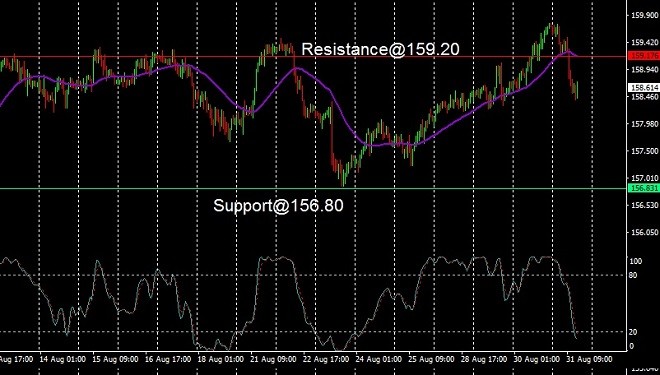
The historical price chart indicates that the EUR/JPY pair is declining after facing resistance at 159.20. The next major support is anticipated only near 156.80. Additionally, the currency pair is trading below its 50-day moving average while the stochastic indicator is in the bearish zone. Therefore, we anticipate the currency pair to remain in a downtrend in the short term.
Disclaimer: Any financial trading analysis offered here is our opinion and is not intended as advice or direction for investors. We cannot guarantee the success of any trades made as a consequence of this article, and we encourage traders to incorporate a strong money management strategy to limit losses when they enter the markets. Please use this article as part of your own research before formulating strategies prior to trading.