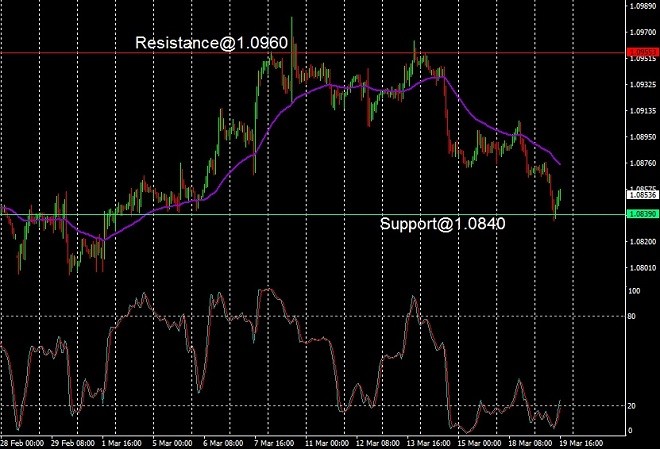
Against the US dollar, the euro stayed range-bound following the publication of positive economic data from the US and the Eurozone. The US building permits data for February topped predictions, while the Eurozone ZEW economic confidence index for March beat projections. Over the course of the previous day, the EUR/USD pair stayed stuck in a range between 1.0839 and 1.0858.
The German ZEW economic sentiment index surged to 31.70 in March from 19.90 in February and blew away forecasts of 20.60. The reported figure, the highest since February 2022, is 11.80 points above the February 2023 reading. On the contrary, there is no change in the assessment of Germany’s economic scenario. The corresponding index stood at -80.50 in March, reflecting a slight improvement from 79.30 in the previous month.
The ZEW economic sentiment index for Europe, reflecting the economic development of the Eurozone, jumped to 33.50 in March from 25 in February and surpassed forecasts of 25.40. However, the situation index for the Eurozone fell to -54.80 in March from -53.40 in February.
Commenting on the reading, ZEW President Professor, Achim Wambach, pointed out a considerable improvement in economic expectations for Germany. However, he noted that over 80 percent of respondents anticipate a potential interest rate cut by the ECB within the next six months. According to him, this expectation contrasts with the more optimistic outlook observed in the German construction industry. Despite this, Achim Wambach believes that the assessment of the overall economic situation remains notably low, which, according to him, somewhat moderates the heightened economic expectations observed.
In the US, the Census Bureau stated that the country’s building permits rose by 1.90% m-o-m in February to 1.518 million units, reflecting the highest level since August 2023, from 1.495 million units in the previous month and surpassed forecasts of 1.50 million. The reported figure is 2.40% above the February 2023 reading of 1.482 million units.
Single-family authorizations were 1.031 million units in February, up 1% from 1,021,000 units in January.
The Census Bureau also stated that housing starts grew by 10.70% m-o-m in February to 1.521 million units from 1.374 million units in January and surpassed forecasts of 1.43 million units. The reported figure was 5.90% above the February 2023 reading of 1.436 million units.
Single-family housing starts were 1.129 million units in February, an increase of 14.80% from 1,012 million units in January.
In the near run, it is anticipated that the positive economic data from the US and Germany will keep the EUR/USD pair range bound.
The historical price chart indicates that the EUR/USD pair is ascending after testing the support at 1.0840. The next resistance is anticipated to be only near 1.0960. Additionally, the stochastics indicator is ascending towards the bullish zone. Therefore, we anticipate the EUR/USD pair to remain in an uptrend in the short term. It would be prudent to open a position after the currency pair crosses above the 50-period moving average.
Disclaimer: Any financial trading analysis offered here is our opinion and is not intended as advice or direction for investors. We cannot guarantee the success of any trades made as a consequence of this article, and we encourage traders to incorporate a strong money management strategy to limit losses when they enter the markets. Please use this article as part of your own research before formulating strategies prior to trading.