The US dollar fell against its peers in the second half of the past trading week mainly due to the relatively dovish position taken by the US Federal Reserve. In particular, the greenback lost its turf against the euro which gained from a low of 1.1401 to 1.1455. Notably, the EUR/USD pair touched a high of 1.1514 on Thursday last week.
The dovish stance of the Fed, mixed non-farm payrolls, turn the greenback weak
The “patient” stance taken by the US Federal Reserve has put a lid on the greenback’s rally. Last week, the Federal Reserve hinted at a temporary end to its ongoing monetary policy tightening measures amidst an unexpected gloomy forecast for the US economy, mainly due to global headwinds and standoffs over commerce and government budget discussions. This implies that the Federal Reserve won’t hike interest rates anytime soon, inscribing a rapid turnaround from previous proclamations that indicated it would systematically increase rates.
The Fed vowed to be “patient,” citing muted inflation and recent economic “cross-currents.” The statement was issued after the Fed’s January meeting, when it maintained interest rates unchanged, as expected.
Fed Chairman, Jerome Powell, opined that the argument supporting rate increases are no longer valid as the inflation is not at a cross-roads, and global growth slowdown and the federal government shutdown has made the US economic outlook less confident.
At the end of a two-day monetary policy meeting, Powell said “We are now facing a somewhat contradictory picture of generally strong U.S. macroeconomic performance alongside growing evidence of cross-currents. Common sense risk management suggests patiently waiting for greater clarity.”
Ironically, if the Fed avoids monetary tightening, then the Fed’s balance sheet would remain bigger than expected earlier. That brings the process of “normalization,” which began after the 2008 financial crisis and recession to an abrupt end. The prevailing benchmark rates are between 2.25% and 2.5%, which is far below historical averages. This implies that the Fed will not have much space to fight any future recession with rate cuts only.
Notably, Trump has routinely criticized the Fed for raising interest rates as he believes that it brings down economic growth. Commenting on the Fed’s decision to halt monetary tightening processes in the near-term, Mohamed El-Erian, a chief financial adviser at Allianz in Newport Beach, California, said: “This marks a full 180 from what the Fed was signaling just a few months ago.”
The Fed’s statement triggered the US dollar selloff which was aggravated by mixed nonfarm payrolls. For the 100th consecutive month, the US economy added more jobs than it lost, in fact, the US added an overwhelming 304,000 jobs in January, almost twice the 165,000 anticipated by analysts. While this sounds exciting, the nonfarm payroll numbers for November were upwardly revised from 176,000 to 196,000, and the payroll figure for December was revised down to 222,000, from the 312,000 reported earlier. The revisions indicate that the job additions in November and December were 70,000 less than previously stated.
Furthermore, the unemployment rate inched to 4% in January, from 3.9% in December. Analysts did not expect any change in the unemployment rate.
All the facts mentioned above indicate that the greenback would remain weak in the short-term.
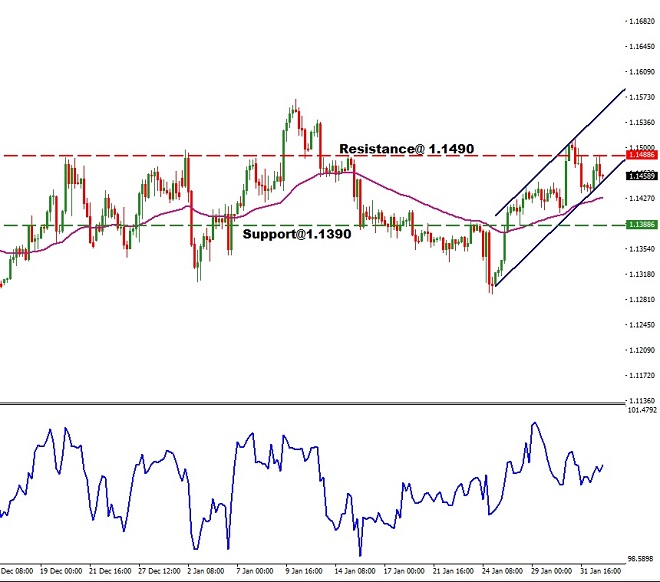
The EUR/USD price chart indicates that the currency pair is moving along an ascending channel as shown in the image below. Furthermore, the currency pair is also trading above its 50-day moving average, while the momentum indicator is making new highs. As a result, we can anticipate the EUR/USD pair to break above the resistance level of 1.1490.
Disclaimer: Any financial trading analysis offered here is our opinion and is not intended as advice or direction for investors. We cannot guarantee the success of any trades made as a consequence of this article, and we encourage traders to incorporate a strong money management strategy to limit losses when they enter the markets. Please use this article as part of your own research before formulating strategies prior to trading.