The uncertainty caused by Brexit pushed the Pound lower against other major currencies in August. Even though the Aussie was under pressure due to Pyongyang’s aggression, still, it managed to climb against the Pound. Since August 3rd, the GBPAUD pair had fallen by about 400 pips to trade at 1.6260. We forecast a deeper decline of the GBPAUD pair due to the arguments presented below.
A recent survey of projections compiled by UBS indicates that several UK companies have suspended their investment plans due to post-Brexit uncertainty. The recent round of negotiations between the UK and EU has not resulted in any concrete agreement. With just 18 months remaining for the exit, the UK has demanded continuous negotiations instead of a one-week-a-month meeting. The UK can ill afford a no-deal situation when it formally exits in March 2019. The lack of progress is expected to keep the Pound under pressure in the weeks ahead.
In addition to the Brexit related uncertainty, the UK economy is also slowing down as indicated by Markit’s survey conducted across the construction sector. The growth of construction firms has declined to a one-year low in August, as indicated by the construction PMI reading of 51.1, down from 51.9 in July.
Analysts had expected a reading of 52.1. The UK economy recorded its slowest half of the year since 2012, mainly due a sharp rise in inflation to about 3%. The rise in inflation has resulted in a decline in consumer spending. Construction makes up about 6% of the UK’s economic output and has failed to offset the decline in consumer spending.
The commodity boom continues to keep the Australian dollar bullish. The price of iron ore had appreciated by nearly 50% in the past two months to trade at $76.50 per ton, last week. Likewise, coking coal has gained more than $50 to trade at $209 per ton. The trend is likely to continue, according to the latest report from BHP Billiton, one of the largest exporters of commodities from Australia, and Macquarie – a reputed Australian bank.
The restructuring of the Chinese steel industry has ensured strong demand for iron ore and coking coal. The Australian economy and its currency will continue to remain buoyant as these two commodities contribute nearly 29.1% of Australia’s export revenue. Thus, poor economic data from the UK is expected to keep the Pound weak against the Aussie.
The GBPAUD pair is moving downwards, after failing to break above the resistance at 1.6310. The bearishness is also indicated by the momentum indicator, which has fallen below the reading of 100. Thus, we can expect the currency cross to reach a level of 1.6050, where the next support exists.
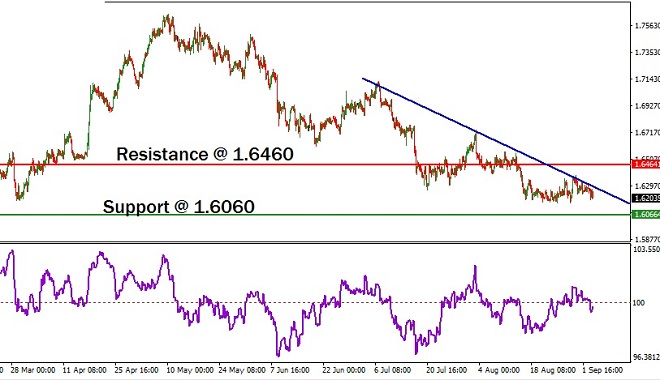
A short position in the spot Forex market would enable us to gain from the probable decline of the currency pair. We would likely open the short position near 1.6280, with a stop-loss order above 1.6370. The short position would be covered when the pair drops to about 1.6050.
In order to gain from the analysis, we are looking at the possibility of buying a put option. The currency pair should be active for one week. Finally, the contract would be purchased when the pair trades near 1.6280 in the currency market.
Disclaimer: Any financial trading analysis offered here is our opinion and is not intended as advice or direction for investors. We cannot guarantee the success of any trades made as a consequence of this article, and we encourage traders to incorporate a strong money management strategy to limit losses when they enter the markets. Please use this article as part of your own research before formulating strategies prior to trading.