
Both Swiss Franc and Japanese Yen are safe-haven currencies. However, the perceived failure of the BoJ’s monetary easing policy kept the Japanese Yen stronger against the Swiss Franc for the past three months. Furthermore, the Swiss Central bank’s (SNB) decision to keep the Franc weak also assisted in the decline of the CHFJPY pair. Thus, in less than three months the CHFJPY fell to 102.80, from a high of 108.75. However, as discussed below, the recent economic news from Switzerland and the action taken by the hedge funds indicate that the CHFJPY is in the process of forming a trend reversal.
On Friday, the Federal Statistical Office of Switzerland reported a 0.3% m-o-m increase in the Producer Price Index (PPI) reading. The increase in the price of petroleum products contributed to the price rise. The reported PPI reading was higher than the analyst’s expectation of a 0.1% increase.
The Swiss unemployment rate of 3.2% in September was unchanged from August and in line with the estimates. It can be remembered that the trade surplus widened to CHF 3.02 billion in August 2016, from CHF 2.86 billion a year ago.
Apart from the positive economic data, there are few other reasons to forecast the strengthening of the Swiss Franc. Firstly, there seems to be no immediate end to the uncertainty caused by the result of the Brexit referendum. Secondly, the Deutsche bank issue in the Eurozone has made the investors more cautious than ever before. All these factors assist in keeping the Franc stronger.
Finally, the probability of the Fed rate hike in December has increased considerably. So, the hedge funds have decreased their long positions in the Yen to the lowest since May. This in turn has led to the weakening of the Yen. Considering the scenario, we expect further upside in the CHFJPY pair in the weeks to come.
Technically, as the chart indicates, the CHFJPY pair has formed a bullish dragon pattern. Thus, we can anticipate an uptrend in the CHFJPY pair.
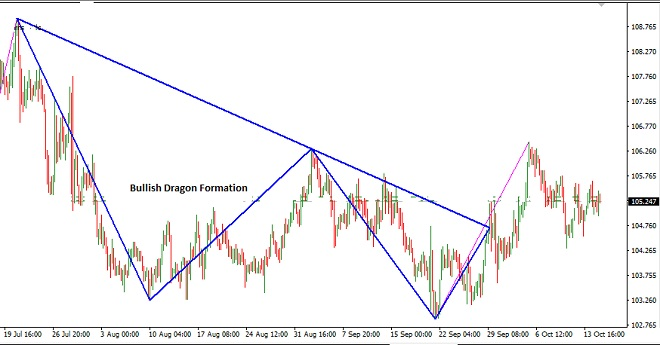
So, a Forex trader can look at the possibility of taking a long position in the CHFJPY pair near the major support at 104.80. To negate risk, a stop-loss order can be placed below 104. The long position can be closed when the CHFJPY pair rises to the immediate technical resistance at 106.10.
Through a reputed binary broker, a trader can invest in a one-touch call option to benefit from the impending rise in the exchange rate of the CHFJPY pair. The strike price for the call option should be about 106. To improve the chances of success in the suggested trade, the binary trader should select an expiry date in the second week of November.
Disclaimer: Any financial trading analysis offered here is our opinion and is not intended as advice or direction for investors. We cannot guarantee the success of any trades made as a consequence of this article, and we encourage traders to incorporate a strong money management strategy to limit losses when they enter the markets. Please use this article as part of your own research before formulating strategies prior to trading.