Yesterday, the euro strengthened against the Aussie after Australia released unexpectedly weak building approval data for January. Additionally, a slight improvement in the Eurozone Sentix Investor Confidence Index for March further supported the euro’s gains against the Australian dollar. As a result, the EUR/AUD pair climbed from a low of 1.6602 to a high of 1.6645 over the past 24 hours.
According to the data published by the Australian Bureau of Statistics, the country’s building approvals fell by 1% m-o-m in January to 12,850 units, following a 10.10% decline in the previous month, which disappointed the market, which was expecting a growth of 3.80%.
Private sector houses declined 9.90% m-o-m in January to 7,461 units. This follows a 1.80% decrease in December. However, private sector dwellings, excluding houses, surged 19.50% to 5,238 units. In December, private sector dwellings, excluding houses, fell by 24.90%.
The value of new residential buildings jumped 19.40% m-o-m in January to A$7.14 billion, following a 6.70% decline in December. Likewise, the value of non-residential buildings increased 12.40% m-o-m in January to A$4.92 billion, following a 10.80% slump in the previous month.
Overall, the value of total residential buildings increased 16.10% m-o-m in January, comprising a 19.40% rise in the value of new residential buildings and a 3.10% decline in alterations and additions.
The Eurozone Sentix Investor Confidence Index improved to -10.50 in March, mirroring the highest level since April 2023, from -12.90 in February and a few notches better than forecasts of -10.80. The reported reading reflects the fifth increase in a row.
In March, the current situation index climbed to -18.50, marking its highest level since June 2023 and the fifth consecutive increase from the previous month’s -20. Similarly, the expectations index edged up to -2.20, reaching its highest level since February 2022 and marking the sixth consecutive increase from February’s -5.50.
The Sentix Investor Confidence Index in the US rose for the fifth consecutive month to 16.90 in March, compared to 12.10 in the previous month, marking its highest level since February 2022.
The current situation index grew to 29.50 in March, reflecting the highest level since March 2022, from 25.30 in February. The expectations index rebounded with a reading of 5 from -0.30.
In Asia (excluding Japan), the Sentix Investor Confidence index almost doubled to 13 in March, reflecting the highest level since February 2022, from 6.70 in February.
The current situation index more than tripled to 10.30 in March, mirroring the highest level since May 2023, from 3.30 in the earlier month. The expectations index grew to 15.80 in March from 10.30 in the prior month. The fifth consecutive monthly increase represents the highest reading since February 2023.
The weak Australian economic data and the slight improvement in the Eurozone Sentix investor confidence index are expected to keep the EUR/AUD pair slightly bullish in the short term.
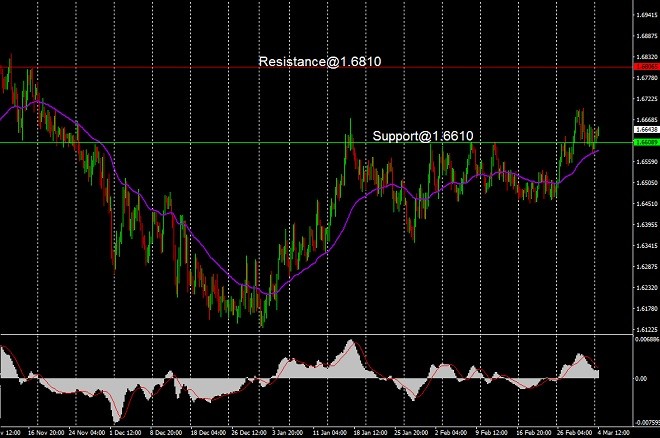
The historical price chart indicates that the EUR/AUD pair is consolidating above 1.6610. The next resistance is anticipated to be only near 1.6810. Additionally, the currency pair is trading above its 50-day moving average, while the MACD indicator is showing a positive reading. Therefore, we anticipate the EUR/AUD pair to remain in an uptrend in the near term.
Disclaimer: Any financial trading analysis offered here is our opinion and is not intended as advice or direction for investors. We cannot guarantee the success of any trades made as a consequence of this article, and we encourage traders to incorporate a strong money management strategy to limit losses when they enter the markets. Please use this article as part of your own research before formulating strategies prior to trading.