The US dollar lost ground against the loonie yesterday following the release of worse-than-anticipated Richmond manufacturing index data for June. The greenback’s decline was fueled by higher-than-anticipated Canadian inflation data for May. Canada’s inflation data has poured cold water on rate-cut expectations. This encouraged the market to place bullish bets on the loonie. Overall, the USD/CAD pair fell from a high of 1.3680 to a low of 1.3660 in the past 24 hours.
According to the data published by Statistics Canada, the country’s consumer price index inched up 0.60% m-o-m in May following a 0.50% increase in the previous month, surpassing forecasts of 0.30% growth.
On a y-o-y basis, the annual inflation rate surged 2.90% in May, following the three-year low of 2.70% in April. The market anticipated Canada’s annual inflation to ease to 2.60%.
The increase was led by a 3.50% y-o-y growth in the prices of transportation in May. Specifically, air transportation prices jumped 4.50% y-o-y in May. Food prices grew by 2.50% y-o-y in May against the backdrop of a 1.50% rise in grocery expenses, reflecting the first increase since June 2023. Furthermore, health and personal care prices increased by 3.60% y-o-y in May. Also, shelter prices rose by 6.40% y-o-y in May. However, household operations, furnishings, and equipment recorded a decline of 1.50% y-o-y in May.
Excluding volatile items, Canada’s core inflation surged 1.80% y-o-y in May following the three-year low of 1.60% in April.
The S&P CoreLogic Case-Shiller U.S. National Home Price NSA Index, encompassing all nine U.S. census divisions, posted a 6.30% y-o-y increase in April, a decline from 6.50% in March.
The 20-City Composite recorded an increase of 7.20% y-o-y in April following a 7.50% in the previous month, surpassing forecasts of a 7% growth. Likewise, the 10-City Composite reported a rise of 8% y-o-y in April, down from an 8.30% growth in March.
According to the Federal Housing Finance Agency, US house prices inched up 0.20% m-o-m in April after remaining unchanged in the previous month but missed forecasts of a 0.30% increase.
On a y-o-y basis, US house prices surged 6.30% in April 2024.
The Richmond manufacturing index declined to -10 in June from 0 in May, missing forecasts of -3.
The report published by the Federal Reserve Bank of Richmond revealed that the decline was led by the shipment index, which fell significantly to -9 in June from 13 in May. Fresh orders fell to -17 in June from -6. Likewise, the employment index improved to -2 from -6.
The Conference Board consumer confidence index decreased to 100.40 in June from 101.30 in the previous month, surpassing forecasts of 100. The present situation index rose to 141.50 from 140.80.
However, the expectation index declined to 73 in June from 74.90 in May. Notably, the reading has been below 80 for five successive months.
The mixed US economic data and higher-than-anticipated Canadian inflation data are expected to keep the USD/CAD pair slightly bearish in the short term.
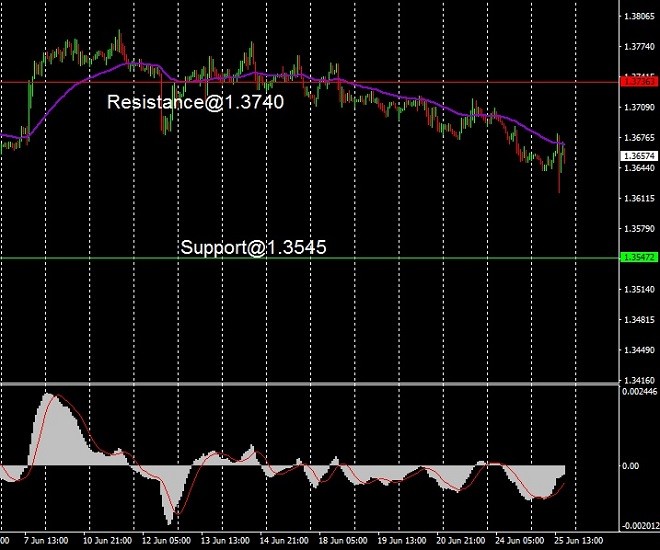
The historical price chart indicates that the USD/CAD pair is descending after facing selling pressure at 1.3740. The next major support is anticipated to be only near 1.3545. Additionally, the currency pair is trading below its 50-day moving average, while the MACD indicator is showing a negative reading. Therefore, we anticipate the USD/CAD pair to remain in a downtrend for the next few trading sessions.
Disclaimer: Any financial trading analysis offered here is our opinion and is not intended as advice or direction for investors. We cannot guarantee the success of any trades made as a consequence of this article, and we encourage traders to incorporate a strong money management strategy to limit losses when they enter the markets. Please use this article as part of your own research before formulating strategies prior to trading.