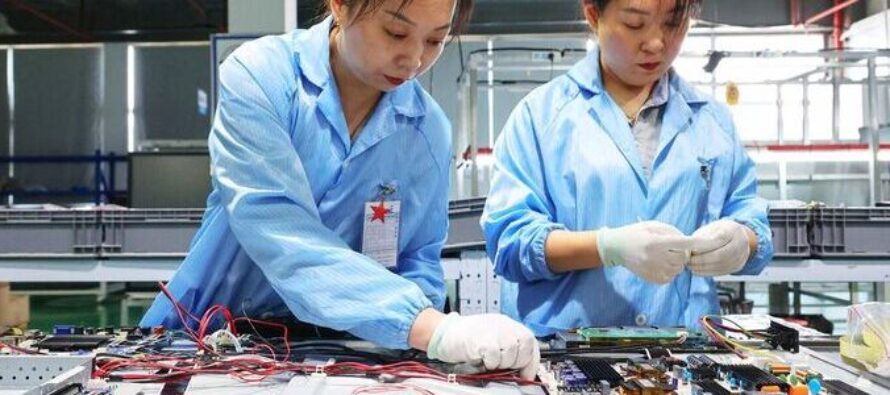
The Chinese yuan was slightly bullish against the greenback yesterday, following signals of a rebound in manufacturing activity. China’s manufacturing PMI, as per the National Bureau of Statistics, rebounded into a positive region in March. Likewise, the Caixin/S&P Global manufacturing purchasing managers’ index hit an 11-month high in March. There were no other major economic data releases. The USD/CNY pair lost 0.05% to trade at 7.25257.
According to the data published by the National Bureau of Statistics (NBS), China’s manufacturing purchasing managers’ index (PMI) rebounded to a positive region with a reading of 50.80 in March from 49.10 in February, surpassing forecasts of 50.10. A reading above 50 indicates expansion, and vice versa. The reported reading reflects the first expansion after five successive months of contraction as factories recorded an increase in demand and expressed optimism about the business scenario in the foreseeable future.
Out of 21 surveyed sectors, 15 recorded expansions in March, an increase from 10 in February.
The production sub-index grew to 52.20 in March from 49.80 in February. Likewise, the sub-index reflecting fresh orders rose to 53 in March from 49 in February, mirroring a strong rebound in both production and demand.
Overall, small enterprises recorded a reading above 50 for the first time in a year. The PMI for large firms increased to 51.10 in March from 50.40 in February.
Zhang Liqun, an analyst at the China Federation of Logistics and Purchasing, pointed out that Beijing’s numerous policies aimed at stabilizing growth and bolstering market confidence are slowly having a positive impact.
Following the Chinese New Year holiday, companies have expedited the resumption of work and production, leading to a significant uptick in market activity. Zhao Qinghe, a senior statistician at the National Bureau of Statistics (NBS), highlighted that while orders for purchasing new equipment have revitalized the market, there is a need for further elaboration and detailing of policies and actions.
The manufacturing sector experienced a notable increase in both exports and imports, marking a positive trend. Companies operating in industries such as chemical fiber, automobiles, and communication devices reported enhancements in their foreign trade activities compared to the previous month.
The NBS also stated that non-manufacturing PMI increased to 53 in March from 51.40 in February and surpassed forecasts of 51.30. The increase was mainly led by the services and construction sectors.
Experts have issued warnings regarding the tough problems confronting enterprise production. These challenges include intensifying market competition and a shortfall in demand. Overall, China’s composite PMI stood at 52.70 in March.
The Caixin/S&P Global manufacturing purchasing managers’ index (PMI) inched up to an 11-month high of 51.10 in March from 50.90 in February and surpassed forecasts of 51. The reported figure reflects the fifth successive month of expansion and the steepest rate of growth in 13 months.
The strong economic data has come amidst higher-than-anticipated export and retail sales data, indicating a solid start to 2024 for the second-largest economy.
Notably, last week, Citi upwardly revised China’s FY 2024 GDP growth forecast to 5% from 4.60%, highlighting policy implementation and recent positive economic data.

Disclaimer: Any financial trading analysis offered here is our opinion and is not intended as advice or direction for investors. We cannot guarantee the success of any trades made as a consequence of this article, and we encourage traders to incorporate a strong money management strategy to limit losses when they enter the markets. Please use this article as part of your own research before formulating strategies prior to trading.