

The Kiwi Dollar strengthened against its peers in the morning session yesterday following the Reserve Bank of New Zealand’s (RBNZ) decision to leave the benchmark interest rate unchanged without any signal of imminent adjustments.
However, the higher-than-expected US inflation data gave rise to expectations of another rate hike by the Federal Reserve. This strengthened the dollar against its rivals, including the New Zealand dollar, in the US session. Overall, the NZD/USD pair declined from a high of 0.6080 to a low of 0.6005 in the past 24 hours.
Specifically, during the Wednesday meeting in Wellington, the Reserve Bank’s Monetary Policy Committee upheld the benchmark interest rate, or OCR (official cash rate), at 5.5%, meeting the expectations of economists surveyed by Bloomberg. This is the sixth successive meeting in which RBNZ opted to keep interest rates steady, emphasizing the necessity of sustaining high rates to manage inflation effectively.
Notably, the RBNZ highlighted the persistence of elevated inflationary pressure expectations and pricing aspirations within the country, identifying continued price increases in the service sector as a potential risk factor.
Expressing confidence in its strategy, the RBNZ affirmed its commitment to retaining the benchmark interest rate at limited levels for an extended time frame, with the objective of bringing consumer price inflation (CPI) back under the targeted range of between 1% and 3% by the end of 2024.
Despite the economy experiencing a recession (two successive quarters of contraction make a recession) and contracting in four out of the last five quarters, market speculations about potential rate cuts in the latter half of the year persist. However, the RBNZ remains cautious about shifting to an accommodative monetary policy as inflationary pressure remains significantly above the 2% target, alongside concerns regarding deep-rooted inflation expectations.
Although the RBNZ previously forecasted inflation returning to the target range by 3Q24, with a gradual slowdown to the midpoint of 2% by the end of 2025, it indicated a reluctance to initiate policy easing until next year. Emphasizing the economy’s anticipated evolution, the RBNZ underscored ongoing weaknesses in business and consumer optimism, which could intensify joblessness and financial strain, potentially easing inflationary pressure at a faster rate.
While most economists anticipate the initial rate cut to happen in August 2024, some institutions, such as ANZ and even Westpac Banking Corp., anticipate delays until next year. Despite these predictions, investors have priced in expectations of two rate cuts by the year’s end.
According to the Bureau of Labor Statistics, the US consumer price index inched up 0.40% m-o-m in March, following a similar increase in the previous month and a notch higher than forecasts of 0.30% growth.
The energy index grew by 1.10% m-o-m in March. The food index inched up 0.10% in the same period. However, the food-at-home index stood unchanged. Furthermore, the food away from home index grew by 0.30% m-o-m in March.
The US CPI surged 3.50% y-o-y in March, an increase from the 3.20% rise recorded in the previous month. Economists had anticipated that US inflation would increase by 3.40% in the reported period. Excluding the food and energy index, the core CPI grew by 2.10% y-o-y in March, reflecting the first 12-month increase. The food index rose by 2.20% y-o-y in March.
The Bureau of Labor Statistics also stated that core CPI inched up 0.40% m-o-m in March following a comparable increase in the earlier month, surpassing forecasts of a 0.30% increase.
The persistent rise in US inflationary pressure has given rise to expectations of further rate hikes in the months ahead. This is expected to strengthen the US dollar against its peers, including the New Zealand dollar.
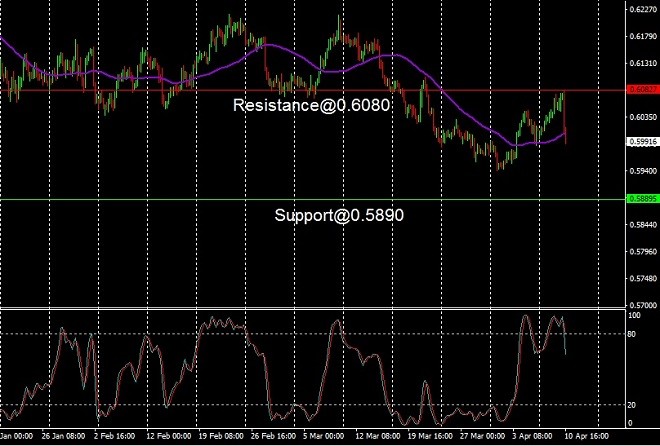
The historical price chart indicates that the NZD/USD pair is descending after failing to break the resistance at 0.6080. The next major support is anticipated to be only near 0.5890. Additionally, the currency pair is trading below its 50-day moving average, while the stochastics indicator is declining towards the bearish zone. Therefore, we anticipate the NZD/USD pair to remain in a downtrend in the near term.
Disclaimer: Any financial trading analysis offered here is our opinion and is not intended as advice or direction for investors. We cannot guarantee the success of any trades made as a consequence of this article, and we encourage traders to incorporate a strong money management strategy to limit losses when they enter the markets. Please use this article as part of your own research before formulating strategies prior to trading.


