
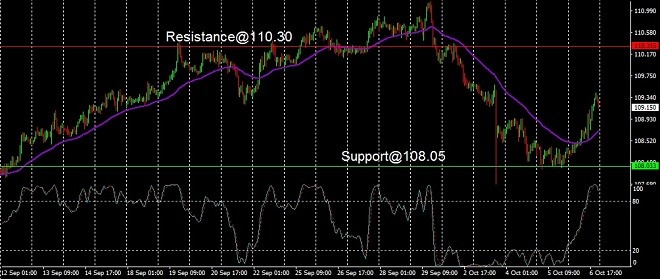
The Canadian dollar rallied against the yen last Friday following the release of overwhelmingly positive Canadian employment data. The Japanese economic data was mixed with household spending, albeit slightly better than anticipated, recording an annual decline in August. Overall, the CAD/JPY pair rallied from a low of 108.05 to a high of 109.24 in the past 24 hours.
According to Japan’s Statistics Bureau, the country’s household spending fell by 2.50% y-o-y in August, following a decline of 5% in the previous month but slightly better than forecasts of a 4.30% decrease.
The latest reading reflects the seventh consecutive decline this year.
Spending on food decreased by 2.50% y-o-y in August, following a decline of 2.80% in July. Likewise, spending on furniture and household utensils fell by 5.10% in August. Also, clothing and footwear dipped by 5.90%. Similarly, consumer spending on education declined by 13.60%. While fuel, light, and water charges inched down by 0.50% in August, medical care slumped by 11.20%. However, culture and recreation rose by 3%. In the same vein, housing expenditures rebounded with a growth of 4.50% in August.
According to the data published by the Ministry of Health, Labor, and Welfare, Japan’s average cash earnings rose by 1.10% y-o-y in August, following a similar increase in July, but missed forecasts of 1.50% growth.
Inflation-adjusted real wages declined by 2.50% y-o-y in August, following a 2.70% dip in July. The reading reflects the decline in real wages for the 17th successive month.
The consumer inflation rate, which includes fresh food prices but is devoid of rent, eased to 3.70%, representing the lowest level in 11 months. Furthermore, overtime pay, a measure of business activity, rose by 1% y-o-y in August after remaining unchanged in July. Base salary grew by 1.60% y-o-y in August, following a 1.40% increase in July.
Japan’s Cabinet Office also stated that the country’s index of leading economic indicators, which is utilized to measure the economic outlook for the forthcoming months based on data such as consumer sentiment and employment, inched up to 109.50 in August from 108.20 in July and surpassed forecasts of 109.
The reported reading reflects the highest level since November 2022, against the backdrop of anticipations that the rebound in the third largest economy, aided by three months of high service sector growth, would continue.
According to Statistics Canada, the country’s employment rose by 63,800 in September, following a rise of 39,900 in the previous month and almost thrice the forecasts of an addition of 22,100 jobs. On average, Canada’s employment has risen by 30,000 per month since the beginning of 2023. The increase in employment was attributed to part-time work, which increased by 48,000.
The employment rate inched up 0.10% to 62% in September, negating a decrease in August.
Educational services added 66,000 jobs in September, following a loss of 44,000 jobs in August. The transportation and warehousing sectors added 19,000 jobs. However, finance, insurance, real estate, rental, and leasing lost 20,000 jobs. The construction sector posted a loss of 18,000 jobs, while information, culture, and recreation reported a loss of 12,000 jobs.
The statistical organization also stated that the unemployment rate was 5.50% in September, unchanged from August and a notch lower than forecasts of 5.60%. Notably, this is the third successive month of no change in unemployment.
The solid Canada employment data is expected to keep the CAD/JPY pair slightly bullish in the short term.
The historical price chart indicates that the CAD/JPY pair is ascending after testing the support at 108.05. The next resistance is anticipated only near 110.30. Additionally, the currency pair is trading above its 50-day moving average, while the stochastic indicator is in the bullish zone. Therefore, we anticipate the CAD/JPY pair to remain in an uptrend in the near term.
Disclaimer: Any financial trading analysis offered here is our opinion and is not intended as advice or direction for investors. We cannot guarantee the success of any trades made as a consequence of this article, and we encourage traders to incorporate a strong money management strategy to limit losses when they enter the markets. Please use this article as part of your own research before formulating strategies prior to trading.