

The Aussie fell against the greenback in the Asian session yesterday following the unexpected decision of the RBA to maintain interest rates. The US economic data (ISM manufacturing PMI, JOLTS job changes) was almost in line with estimates. This enabled the US dollar to consolidate its gains later in the day. Overall, the AUD/USD pair declined from a high of 0.6725 to a low of 0.6605 in the past 24 hours.
According to the Australian Bureau of Statistics, the country’s building approvals fell by 7.70% m-o-m in June, following a 20.60% surge in the previous month and slightly better than forecasts of a 7.90% decline.
Private sector houses decreased 1.30% m-o-m in June to 8,048 units, following a 0.80% increase in May. Additionally, private sector dwellings, excluding houses, plunged by 21% in the same period, following a jump of 60.40% in May. The value of total buildings grew by 1.20% in June, following a 11.40% surge in May.
Furthermore, the value of aggregate residential building approvals declined by 4.60% in June. This comprises a 4.60% fall in new residential buildings and a 4.70% decline in alterations and additions.
The value of non-residential buildings rose by 7.60% in June, following a 7.20% increase in May. However, the value of new residential buildings dipped by 4.60% in the same period.
For the second consecutive month, the Reserve Bank of Australia (RBA) left the benchmark interest rates unchanged at 4.10%, defying market expectations for a 25 bps increase. Notably, the Australian central bank has lifted interest rates by a total of 400 bps since May 2022 to reach the highest level in 11 years.
Despite the rate hike, Australia continues to face high inflationary pressure. At the end of the June 2023 quarter, the country’s consumer price index rose by 6% from a similar period last year. The reported inflation is triple the RBA’s targeted level of 2%. However, it has come down from the peak of 7% recorded in the March 2023 quarter.
The Reserve Bank of Australia (RBA) has provided clarification regarding its decision to maintain the current benchmark interest rates. The move allows for additional time to evaluate the effects of the recent interest rate hikes and to analyze the overall economic scenario.
The central bank acknowledged that growth in household consumption remains weak. Furthermore, the RBA has pointed out that labor market conditions continue to remain tight, but slightly better than earlier scenarios.
The Reserve Bank of Australia (RBA) reiterated its intention of bringing inflation to its target level. Additionally, in accordance with the central bank, the most recent data indicate that inflation is expected to align with the target range of 2-3% within the projected timeframe. The Reserve Bank of Australia (RBA) believes that additional interest rate hikes may be required in order to achieve the desired inflation level within the expected timeframe. However, any decision regarding this matter will be made following a thorough evaluation of economic data and consideration of associated risks.
Yesterday’s Reserve Bank of Australia (RBA) policy meeting holds significance as it represents Philip Lowe’s second-last meeting in his capacity as governor. Michele Bullock will take over as governor of the Reserve Bank of Australia (RBA) following the completion of his seven-year period on September 17th.
According to the data published by the Institute for Supply Management, the US manufacturing purchasing managers’ index increased to 46.40 in July from 46 in May but missed forecasts of 46.90. A reading below 50 indicates contraction, and vice versa.
The figure represents an eighth month of contraction following a 30th successive month of growth. The new orders index improved to 47.30 in July from 45.60 in June. Likewise, the production index increased to 48.30 in July from 46.70 in June. Additionally, the backlog of orders index rose to 42.80 from 38.70.
The employment index fell to 44.40 in July from 48.10 in June. Similarly, the new export orders index declined to 46.20 from 47.30. Furthermore, the inventories index rose to 46.10 from 44.
According to the Job Openings and Labor Turnover Survey (JOLTS) data published by the Bureau of Labor Statistics, the number of job openings in the US stood almost unchanged at 9.58 million in June, compared with 9.82 million in the previous month and slightly lower than the 9.61 million openings anticipated by economists.
The healthcare and social assistance sectors recorded 136,000 job openings. Likewise, state and local governments (excluding education) reported 62,000 job openings. However, transportation, warehousing, and utilities reported a decline of 78,000 job openings. Furthermore, state and local government education-related jobs decreased by 29,000. Federal government job openings fell by 21,000.
The unexpected dovish move by the RBA is expected to keep the AUD/USD pair slightly bearish in the short term.
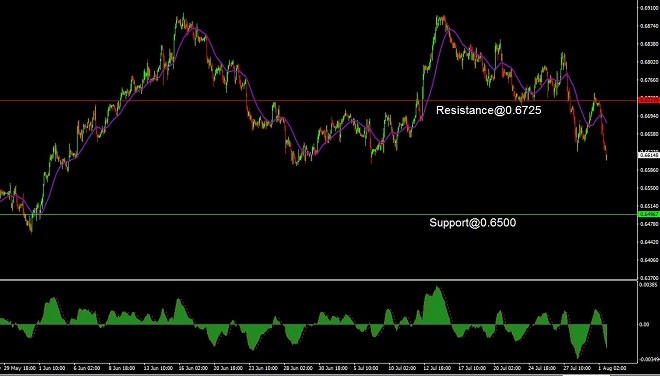
The historical price chart indicates that the AUD/USD pair is declining after failing to break the resistance at 0.6725. The next support is anticipated to be only near 0.6500. Additionally, the currency pair is trading below its 50-day moving average, while the MACD indicator is showing a negative reading. Therefore, we anticipate the AUD/USD pair to remain in a downtrend in the near term.
Disclaimer: Any financial trading analysis offered here is our opinion and is not intended as advice or direction for investors. We cannot guarantee the success of any trades made as a consequence of this article, and we encourage traders to incorporate a strong money management strategy to limit losses when they enter the markets. Please use this article as part of your own research before formulating strategies prior to trading.


