

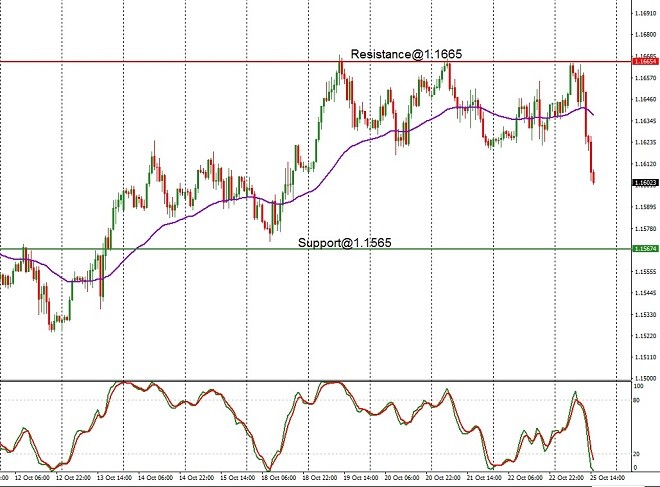
The Eurodollar declined against the greenback yesterday following the release of a lower-than-anticipated decline in the German Ifo business climate index. The Eurodollar’s downtrend was also fueled by the downgraded economic growth outlook issued by the Bundesbank of Germany. There were no other major economic releases on Monday. Overall, the EUR/USD pair declined from a high of 1.1665 to a low of 1.1600 in the past 24 hours.
According to the data published by the German Ifo Institute, the business climate index inched lower for the fourth consecutive month to 97.70 in October, from 98.90 in the earlier month, and missed the reading of 97.90 anticipated by economists surveyed by Reuters. Furthermore, the reported reading was the lowest since April. The decline was mainly due to supply chain issues that caused a drop in the factory output in Europe’s economic powerhouse.
Notably, companies’ assessment of the current situation also fell to 100.10 in October, from 100.40 in the prior month. Also, the expectations index declined to 95.40, from 97.40.
While the manufacturing sector dropped to 17.20 in October, from 20 in the prior month, the service sector decreased to 16.50, from 19.10 in the same period. The trade index plunged to 3.70 in October, from 9 in September. However, the construction index improved to 12.90, from 11.10.
The government is anticipated to trim its outlook for GDP growth in 2021 as top institutions have slashed their joint prediction to 2.40%, from 3.70% forecast earlier. For 2022, the institutes forecast growth of 4.80%.
In a separate report, Bundesbank has stated that the country’s economic growth will probably decline sharply in the current quarter as multiple sectors suffer from supply chain issues and a decrease in demand.
Specifically, the centra “[…] full-year growth is now likely to be “significantly” below its 3.7% prediction made in June.”
The German economy recorded sharp expansion in summer, but anticipated supply chain issues continue to harm the country’s car manufacturing industry. Likewise, a rise in energy costs and unending worries about the COVID-19 pandemic could further harm consumer morale.
Bundesbank also stated that the robust momentum witnessed so far in the service sector is likely to decrease. Furthermore, the manufacturing industry will probably face delivery issues.
The automobile industry has been severely affected by the scarcity of semiconductors, and economists anticipate the issue to last through several months next year. Almost all the issues faced by the industry are due to supply chain problems as order backlogs remain strong. This has caused a considerable gap between supply and demand.
Bundesbank anticipates the service sector to be affected in the months ahead as specific measures to contain pandemic will continue to be enforced. The central bank also expects inflationary pressure to increase due to high energy prices and the withdrawal of a reduction in value-added tax.
The decline in the German Ifo business climate index and weak outlook issued by the Bundesbank is expected to keep the Eurodollar slightly bearish against the greenback in the short term.
The historical price chart indicates that the Eurodollar is declining against the US dollar after failing to break the resistance at 1.1665. The next support is anticipated only near 1.1565. Additionally, the stochastics indicator is in the bearish zone. Therefore, we are anticipating the currency pair to remain in a downtrend in the short term.
Disclaimer: Any financial trading analysis offered here is our opinion and is not intended as advice or direction for investors. We cannot guarantee the success of any trades made as a consequence of this article, and we encourage traders to incorporate a strong money management strategy to limit losses when they enter the markets. Please use this article as part of your own research before formulating strategies prior to trading.


