The Aussie gained ground against the yen yesterday following the RBA’s (Reserve Bank of Australia) decision to hold the benchmark interest rates unchanged at a 12-year high. The central bank also stated that the cash rate could remain the same for nearly six months as there are lingering concerns about inflation. Overall, the AUD/JPY pair traded in a range of between 93.44 and 95.50 in the past 24 hours.
According to the data published by Japan’s Ministry of Health, Labour, and Welfare, the country’s average cash earnings rose by 4.50% y-o-y in June to ¥498,884 (or $3,480), after increasing by 2% in the previous month and surpassing forecasts of 2.30%.
The reported figure reflects the highest figure since January 1997, backing the government’s transition to an interest rate hike cycle. It can be remembered that Japan’s nominal wage increase surpassed the 2.60% core consumer inflation rate in June, paving the way for the first hike in inflation-adjusted real wages since February 2022 at 1.10%.
The increase was led by an 11.70% y-o-y surge in living-related and personal services and amusement in June. Likewise, finance and insurance recorded a growth of 11%. On the contrary, mining and quarrying of stone and gravel posted a 9.40% y-o-y decline in wages in June.
Similarly, real estate, goods rental, and leasing reported a 5.80% decrease. Wages in the scientific research, professional, and technical sectors recorded a 3.90% decline. Notably, Japan’s central bank (BoJ) lifted its benchmark interest rate “to about 0.25%” last month and indicated its willingness to lift interest rates further.
Furthermore, real wages increased by 1.10% y-o-y in June, increasing for the first time in 27 months, following a 1.30% decline in May. Regular pay for permanent workers grew by 2.70% y-o-y in June following a revised 2.60% increase in May, a signal that the exorbitant pay hikes granted by companies in the wage discussions earlier this year are fueling household income.
According to the data published by the Ministry of Internal Affairs and Communications, Japan’s household spending fell by 1.40% y-o-y in June, following a 1.80% decline in the previous month and worse than forecasts of a 0.90% decrease. The reported figure reflects the fifth decrease so far in 2024.
The decline was led by a 23.60% y-o-y drop in housing expenditure in June. Likewise, fuel, light, and water expenses fell by 7.30%. Culture and recreation dipped by 1%. Also, medical care spending grew by 2.30% y-o-y in June, following a 6.40% increase in the previous month.
Education expenses rose by 7.30% y-o-y in June. Furthermore, food expenses rose by 1.50% in June, reflecting the first increase in three months. Notably, furniture and household utensils jumped 23.70% y-o-y in June.
On an m-o-m basis, personal spending inched up 0.10% in June but missed forecasts of 0.20% growth.
In the Asian session yesterday, the Reserve Bank of Australia, following the policy meeting, announced its decision to leave the interest rates unchanged at 4.35%. The decision, reflecting the sixth successive time the RBA has left benchmark interest rates unchanged since November 2023, was in line with the market’s estimates.
Reserve Bank of Australia (RBA) Governor Michele Bullock stated that the current cash rate aligns with the prevailing economic conditions, although she cautioned that inflation remains elevated. During a post-decision press conference, Bullock emphasized that the board considers the current cash rate relevant for balancing inflation and job creation goals. Additionally, she indicated that a reduction in the benchmark interest rate is not anticipated shortly, as the board’s current outlook does not support such a move based on the present information.
The decision to leave interest rates unchanged is expected to keep the Aussie slightly stronger against the yen in the short term.
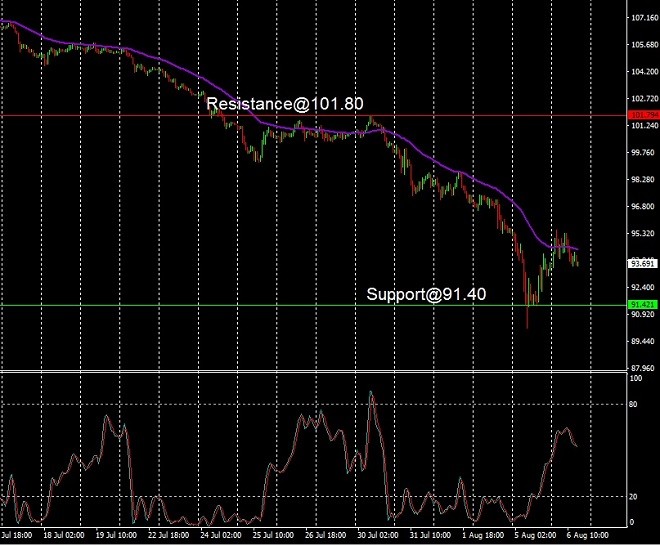
The historical price chart indicates that the pair is rising after testing the support at 91.40. The next resistance is anticipated to be only near 101.80. Additionally, the stochastic indicator is ascending towards the bullish zone. Therefore, we anticipate the AUD/USD pair to remain in an uptrend for the upcoming trading sessions. It would be prudent to open a long position after the currency pair closes above its 50-day moving average.
Disclaimer: Any financial trading analysis offered here is our opinion and is not intended as advice or direction for investors. We cannot guarantee the success of any trades made as a consequence of this article, and we encourage traders to incorporate a strong money management strategy to limit losses when they enter the markets. Please use this article as part of your own research before formulating strategies prior to trading.