

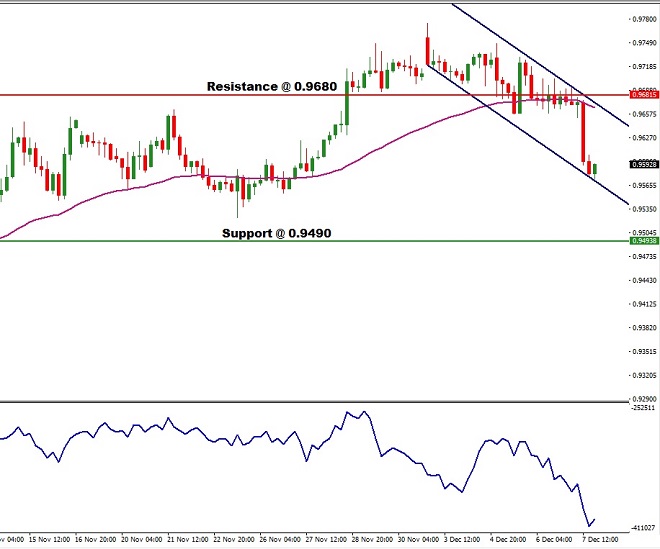
The Australian dollar fell against the Canadian dollar on Friday after the release of surprisingly strong employment data and oil price rallies. From a high of 0.9770, the AUDCAD pair has declined to 0.9590 in the past week. It is not only because of positive data from Canada but also the economic slowdown in Australia, deterioration of the construction sector, and the dovish stance of the RBA.
The slowdown in economic growth keeps the Aussie bearish
Last week, the Australian Bureau of Statistics reported that the country’s economic growth slowed in the September quarter, mainly due to a decline in household spending.
The statistical organization reported that the GDP grew by a mere 0.3% in the third quarter, missing analysts’ expectations for an increase of 0.6%. The published figures represent the weakest quarterly expansion after the economy contracted in the third quarter of 2016. In the previous quarter, the economy grew by 0.9%, unchanged from the earlier estimate. The quarterly miss has caused the annual GDP growth to decline sharply to 2.8%, much lower than the 3.3% pace expected.
Bill Evans, the chief economist at Westpac Bank, believes that it is almost impossible for the Australian economy to grow by 3.5% in 2018 and attain RBA’s forecast.
Evans said “With the first three quarters of the year totaling 2.2%, the December quarter would have to print growth of 1.3%, a highly unlikely event. We can expect the Bank to lower its forecast for GDP growth in 2018 from 3.5% to 3.0% when it next releases its forecasts on February 9th, 2019.”
One of the sectors which is affecting the GDP growth is the construction industry, which is the third-largest employer in Australia behind healthcare and retail. In November, construction activity levels fell sharply due to a decline in the housing sector.
In seasonally adjusted terms, the Australian Industry Group’s (Ai Group) Performance of Construction Index (PCI) declined to 44.5 points in November, down 1.9 points from the prior month. The reported figures were the weakest since February 2015.
Commenting on the construction sector, Peter Burn, Head of Policy at the Ai Group said: “A further lift in infrastructure activity was not able to offset steeper falls in residential construction sub-sectors in November. Across the construction sector as a whole, activity, employment and new orders all fell in the month which was the third consecutive month of contraction in this important part of the economy.”
The GDP and construction data indicate that 2019 could turn out to be a tough year for the overall Australian economy.
For the past several months, the Reserve Bank of Australia has been saying that the next interest rate movement will be probable on the upside. However, the statement made by the bank’s deputy governor Guy Debelle last Thursday evening at a business economists’ dinner contradicted the view. The deputy governor opined that rate cuts were possible in the coming months.
More importantly, Debelle said that RBA could implement quantitative easing (QE), similar to the one orchestrated by the US Federal Reserve, if necessary. The dovish statement and weak economic data are expected to keep the Aussie bearish.
In Canada, the economy added 94,000 jobs in November, compared with 11,200 in the earlier month and greater than 10,500 expected by analysts. Notably, the gains were driven by full-time work. Furthermore, the unemployment rate fell 0.2% to 5.6%, the lowest since 1976. In the year ended November, employment increased by 219,000 or 1.2%.
In the commodity market, oil prices gained over 5% on Friday as members of the OPEC cartel agreed to slash output to drain excessive global fuel inventories and indirectly boost the price traded market. Benchmark Brent crude oil gained $3.26 a barrel to reach a high of $63.32. The overwhelmingly positive employment data and crude oil price rally has turned the Canadian dollar bullish. Therefore, we can expect the AUDCAD pair to decline in the short-term.
Technically, the AUDCAD pair has broken the support at 0.9680. The currency pair has also broken its 50-day moving average. Furthermore, the accumulation indicator is making new lows. As a result, we can expect the AUDCAD pair to remain in the downtrend for the short-term.
Disclaimer: Any financial trading analysis offered here is our opinion and is not intended as advice or direction for investors. We cannot guarantee the success of any trades made as a consequence of this article, and we encourage traders to incorporate a strong money management strategy to limit losses when they enter the markets. Please use this article as part of your own research before formulating strategies prior to trading.


