A series of positive news enabled the Euro to rally against the Yen for the past two weeks. Firstly, the unexpected changes made by the BoJ (Bank of Japan) to its asset purchase program weakened the Yen. Secondly, the ECB’s decision to keep the interest rates on hold in the September meeting also assisted the Euro to remain strong. On the other hand, the FOMC’s (Federal Open Market Committee) decision to leave the interest rates unchanged weakened the US dollar considerably. The Greenback’s weakness indirectly supported the rise of the Euro. However, the EURJPY has shown signs of reversal due to the reasons mentioned below.
The most important reason which may trigger a downfall in the Euro is the market’s expectation of a Fed rate hike in December. In the US, the number of nonfarm jobs added in September was 156,000. It was lower than the 171,000 jobs that were expected to be added. Still, many analysts believe that the job data is sufficient enough for the Fed to tighten the monetary policy.
Alvin Tan, a currency strategist at Société Générale, is of the opinion that the numbers were enough for the Fed to be on track and maintain the momentum in the US dollar. Toeing a similar line, the Cleveland Fed President Loretta Mester, a voting member of the policy-setting committee, opined that the numbers were solid enough to call for a rate hike soon. Based on these statements, we can expect speculators to push the Greenback upwards soon. This would obviously weaken the Eurodollar.
The unresolved Deutsche bank saga, on the other hand, is expected to bolster the Yen in the coming days. The US Department of Justice has demanded $14 billion from the German’s top-rated bank to settle an investigation into the alleged misselling of mortgage-backed securities. The news has eroded the bank’s market capitalization by about $1.34 billion so far. The largest chunk of the shares is held by the Qataris who are now mulling at the prospects of making additional investments if required. The uncertainty in the final settlement value is expected to turn the investors’ attention towards safe-haven assets such as the Japanese Yen. Thus, we can expect the EURJPY to decline in the coming week.
The H4 historic chart shows that the EURJPY pair faces stiff resistance at 116.40. The stochastic oscillator is descending after hitting the overbought level of 100. Currency traders can anticipate the EURJPY to decline to the support level of 112.60.
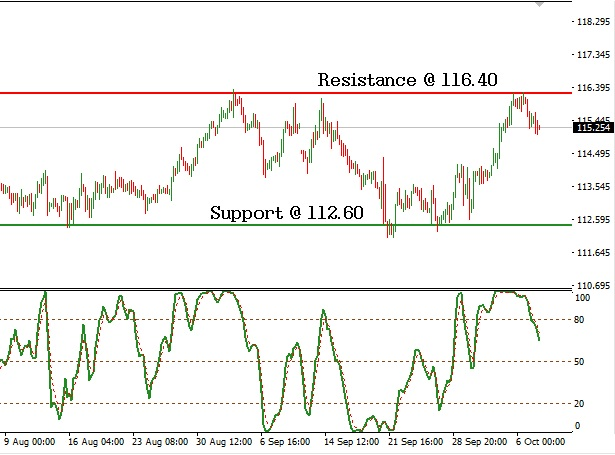
To capitalize on the decline, a short position can be opened near 115.50. To safeguard the account from large losses, a stop-loss order can be placed above 116.60. The short position can be closed when the pair declines to a low of about 114.
Investing in a one-touch put option would enable a binary trader to realize commendable returns as long as the forecast turns out to be true. The strike price for the put option should be greater than or equal to 114. The trader should also ensure that the put option should remain valid until the end of the second week of November.
Disclaimer: Any financial trading analysis offered here is our opinion and is not intended as advice or direction for investors. We cannot guarantee the success of any trades made as a consequence of this article, and we encourage traders to incorporate a strong money management strategy to limit losses when they enter the markets. Please use this article as part of your own research before formulating strategies prior to trading.