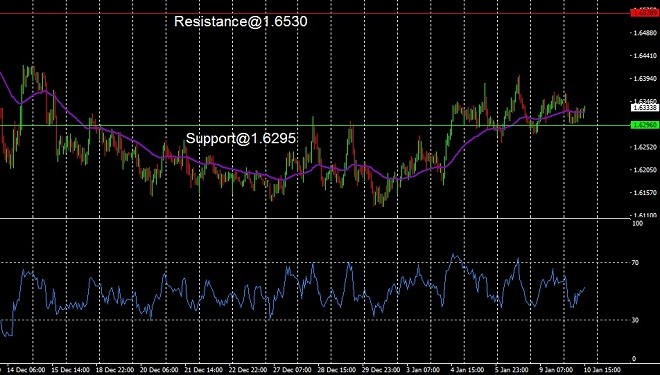
The euro remained range-bound against the Aussie following the release of solid economic data from both the Eurozone countries and Australia. While Australia’s inflation data for November was almost in line with economists’ forecasts, the French industrial production data for the same period surpassed the market’s anticipations. Overall, the EUR/AUD pair traded in a narrow range of between 1.6295 and 1.6360 in the past 24 hours.
According to the Australian Bureau of Statistics, the country’s consumer price index rose by 4.30% y-o-y in November, following a 4.90% rise in the previous month and a notch lower than forecasts of 4.40% growth.
The increase was led by a 6.60% rise in housing prices. Likewise, food and non-alcoholic beverages posted an increase of 4.60% y-o-y in November. On an m-o-m basis, food and non-alcoholic beverage prices inched up 0.80%. Insurance and financial services surged by 8.80% y-o-y in November, while alcohol and tobacco prices jumped 6.40% in the same period. Notably, annual trimmed mean inflation was 4.60% y-o-y in November, a decrease from a growth of 5.30% in October.
New dwelling prices inched up 5.50% y-o-y in November. Also, electricity prices grew by 10.70% y-o-y in November. On an m-o-m basis, electricity prices inched up 0.40% in November.
Automotive fuel prices increased 2.30% y-o-y in November, following a growth of 8.60% in October. On an m-o-m basis, automotive fuel prices inched up 0.50% in November.
Holiday travel and accommodation prices inched up 0.30% y-o-y in November. On a m-o-m basis, holiday travel and accommodation prices grew by 2.70% in November.
According to the National Institute of Statistics and Economic Studies (INSEE), French industrial production grew by 0.50% m-o-m in November, following a decline of 0.30% in October and a few notches higher than forecasts of a 0.10% increase.
In the manufacturing sector, output inched up 0.30% m-o-m in November, following a 0.20% rise in October. Specifically, machinery and equipment goods manufacturing rose by 2.80% m-o-m in November. The mining and quarrying, energy, and water supply sectors rebounded with a growth of 1.80% in November following a contraction of 2.70% in October.
However, transport equipment manufacturing recorded a decline of 0.80% m-o-m in November. Likewise, motor vehicles, trailers, and semi-trailers posted a decline of 5.50%. Furthermore, food products and beverage manufacturing fell by 0.80% in the reported period. Similarly, coke and refined petroleum manufacturing inched down 0.60%.
On a y-o-y basis, manufacturing output declined by 0.30% in November. In particular, mining and quarrying, energy, and water supply manufacturing output rose by 7.40% y-o-y in November. Likewise, transport equipment manufacturing increased by 6%. Also, machinery and equipment goods manufacturing grew by 3.20%y-o-y in November.
According to the Italian National Institute of Statistics (Istat), the country’s retail sales (value) inched up 0.40% m-o-m in November, following a similar increase in the previous month and greater than forecasts of a 0.20% growth.
Correspondingly, Italy’s retail sales volume inched up 0.20%m-o-m in November.
On a y-o-y basis, retail sales value increased by 1.50% in November 2023. However, retail sales volume fell by 2.20% in the same period. Online sales inched up 0.60% y-o-y in November 2023.
The solid economic data from Australia and the Eurozone is expected to keep the EUR/AUD pair range-bound in the short term.
The historical price chart indicates that the EUR/AUD pair is rising after testing the support at 1.6295. The next major resistance is anticipated only near 1.6530. Additionally, the currency pair is trading above its 50-day moving average, while the RSI indicator is showing a reading above 50. Therefore, we anticipate the EUR/AUD pair to remain in an uptrend in the near term.
Disclaimer: Any financial trading analysis offered here is our opinion and is not intended as advice or direction for investors. We cannot guarantee the success of any trades made as a consequence of this article, and we encourage traders to incorporate a strong money management strategy to limit losses when they enter the markets. Please use this article as part of your own research before formulating strategies prior to trading.