
The Australian dollar has been on a decline since the beginning of this year. There are two factors that contribute to the strength of the Australian currency: the price of commodities and the interest rates. As we discuss below, Australia is at a disadvantage when it comes to commodities prices, compared to last year. Secondly, in March this year, Australia lost its edge over the US with respect to interest rate differentials. All these factors have made the Aussie trade near its yearly low. We expect the AUDUSD pair, which is currently trading at 0.7390, to decline further in the near-term future.
The Aussie, which has so far declined about 5.30% in 2018, is now suffering due to the country’s close trade ties with China. The trade war between the US and China has decreased the appetite for risky assets. In such a scenario, commodity currencies such as the Australian dollar and the Kiwi dollar are usually the worst affected.
Australia has little to say in the trade war between the US and China. The 10% import tariffs on $50 billion worth of Chinese goods were met with a similar retaliation by China. Last week, Trump ordered the trade secretary to prepare another $200 billion worth of Chinese goods for imposing additional tariffs at a rate of 10%.
If Trump goes ahead in imposing additional trade tariffs then it would certainly affect China’s economy. Australia, whose largest trading partner is China, will be certainly be affected by such a move. Australia derives a major portion of its export revenue from Iron, coal, and natural gas. The commodity prices are usually very sensitive to the changing forecasts of global growth.
While raising interest rates in June, the US Federal Reserve gave a hint of two more hikes later this year. The prevailing Fed rate is already 25 basis points above the Australian interest rate of 1.5%. The Reserve Bank of Australia has categorically stated that there is no possibility of a rate hike this year due to low inflation and lack of reasonable wage growth. If the Fed goes ahead in implementing two more hikes, then the interest rate differentials will further widen and make the Australian dollar unattractive to investors.
The US Census Bureau reported yesterday a contraction in the trade deficit to $64.8 billion in May, from $67.30 in the previous month, and better than analysts’ estimates of $68.90 billion. Exports grew $2.9 billion m-o-m in May to $143.90 billion, while imports grew $0.4 billion to $208.40 billion. The economic data and geopolitical developments are expected to keep the AUDUSD pair in a downtrend.
Technically, the AUDUSD pair has broken major support at 0.7550. The MACD indicator is making new lows in the negative zone. Furthermore, the next major support exists only at 0.7160. Therefore, we are expecting the AUDUSD pair to decline further.
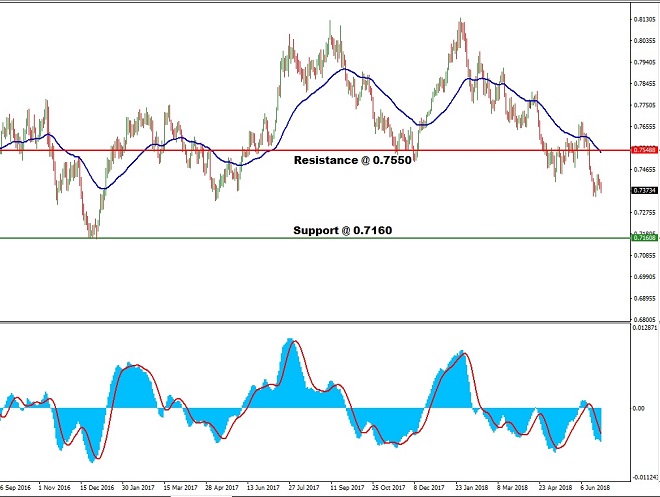
We may capitalize on the current downtrend by establishing a short position in the Forex market. The position may be opened near 0.7390, with a stop-loss order above 0.7500. We intend to cover the short position near 0.7180.
Additionally, we may also purchase a put option in the binary market to take advantage of the trade setup that has a high probability of success. The option may be bought when the AUDUSD pair trades near 0.7390. We are also planning to choose a date around July 7th for the expiry of the contract.
Disclaimer: Any financial trading analysis offered here is our opinion and is not intended as advice or direction for investors. We cannot guarantee the success of any trades made as a consequence of this article, and we encourage traders to incorporate a strong money management strategy to limit losses when they enter the markets. Please use this article as part of your own research before formulating strategies prior to trading.