
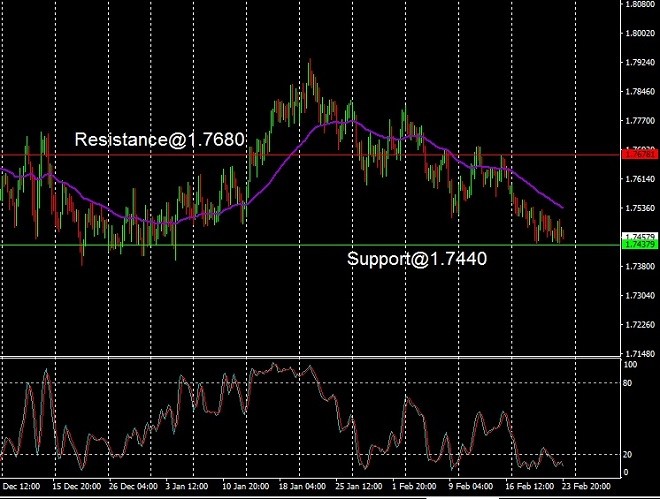
The euro strengthened against the Kiwi dollar on Friday following the release of weak New Zealand retail sales data for the December 2023 quarter. The euro’s consolidation was also aided by slightly better-than-anticipated German business climate index data for February. Overall, the EUR/NZD pair traded in a range of 1.7438 to 1.7492.
According to Statistics New Zealand, the country’s retail sales fell by 1.90% q-o-q in the December 2023 quarter to N$25 billion, following a 0.80% decline in the previous quarter and worse than forecasts of a 0.20% decrease. The reported figure reflects the eighth successive quarterly decline.
Also, the total value of retail sales declined by 1.50% q-o-q (or N$459 million) in the December 2023 quarter to N$30 billion.
In the December 2023 quarter, compared with a similar period last year, the cumulative value of actual retail sales inched down 0.40% (or N$120 million) to N$33 billion. Overall, the aggregate value of actual stock was N$9.40 billion in December 2023, a decrease of 4.10% (N$401 million) from December 31, 2022.
14 out of 15 industries had lower sales volumes in 4Q 2023 compared with 3Q 2023.
The decline was led by motor vehicle and parts retailing, which recorded a decrease of 2.50% q-o-q in sales volumes in the December 2023 quarter. Likewise, food and beverage services fell by 2.40%. Fuel retailing decreased by 3.60%, while clothing, footwear, and personal accessories dipped by 4%. Recreational goods retailing posted a fall of 6.20%q-o-q in 4Q 2023.
12 out of 15 industries reported a decline in sales values in the December 2023 quarter compared with the previous quarter. The decline was led by motor vehicle and parts retailing, which recorded a decrease of 3.50%q-o-q (or N$142 million) in sales values in 4Q 2023. Accommodation posted a decline of 4.80% (or N$67 million). Food and beverage services reported a decrease of 1.40% (or N$57 million), while hardware, building, and garden supplies posted a drop of 2% (or N$56 million). Recreation goods retailing reported a dip of 6.10% (or N$50 million).
According to the German Ifo Institute, the country’s business climate index increased to 85.50 in February from a three-and-a-half-year low of 85.20 in January, in line with economists’ estimates.
The expectations index improved to 84.10 in February from 83.50 in January, in line with economists’ estimates. The current business situation index stood unchanged at 86.90 in February, reflecting the weakest level since July 2020.
The index representing service providers’ sentiment improved to -4.10 in February from -4.80. Likewise, construction business sentiment inched up to -35.40 from -35.80. However, manufacturers’ sentiment worsened to -17.40 from -15.80. Similarly, traders’ sentiment fell to -30.80 from -29.70.
Despite the improvement, Germany’s largest economy is on the verge of slipping into recession. In 2023, the country’s economy contracted by 0.30%, reflecting the worst performance among any of the major economies.
Last Wednesday, the German government downwardly revised its economic growth outlook for 2024 to 0.20% from the earlier forecasts of 1.30%, as sluggish worldwide demand, global uncertainty, and consistently high inflationary pressure have poured cold water on hopes of an economic recovery.
The weak New Zealand retail sales data is expected to keep the EUR/NZD pair slightly bullish in the short term.
The historical price chart indicates that the EUR/NZD pair is consolidating above the support level of 1.7440. The stochastics indicator is also in the oversold region. Therefore, we can expect an uptrend to begin in the days ahead. The next resistance is anticipated to be only near 1.7680. It would be prudent to open a long position after the currency pair firmly closed above the 50-day moving average.
Disclaimer: Any financial trading analysis offered here is our opinion and is not intended as advice or direction for investors. We cannot guarantee the success of any trades made as a consequence of this article, and we encourage traders to incorporate a strong money management strategy to limit losses when they enter the markets. Please use this article as part of your own research before formulating strategies prior to trading.