
Video Source: Bloomberg Television on YouTube
The pound lost ground against the Kiwi dollar yesterday, despite the release of weak economic data from both the UK and New Zealand. While New Zealand’s retail sales data for the June quarter was worse than expectations, the UK’s flash manufacturing PMI data for August hit more than a three-year low. This encouraged market participants to make bets against the pound. Overall, the GBP/NZD pair declined from a high of 2.1450 to a low of 2.1270 in the past 24 hours.
According to Statistics New Zealand, the country’s retail sales volume fell by 1% q-o-q in the June 2023 quarter to N$25 billion, following a 1.60% decrease in the March 2023 quarter and missing forecasts of a 0.40% decline.
Furthermore, the total value of retail sales inched down by 0.20% q-o-q (or N$60 million) in 2Q23 to N$30 million. Ten out of 16 regions posted higher sales values.
The total value of actual retail sales was N$29 billion, an increase of 2.50% (or N$725 million) from the June 2022 quarter. Additionally, the total value of actual stock was N$9.40 billion at the end of June 2023, an increase of 0.80% (or N$75 million) from June 2022.
Eleven out of 15 industries recorded lower sales volumes in the second quarter. Motor vehicle and parts retail sales volumes grew by 3.70% q-o-q in the June 2023 quarter. However, food and beverage services fell by 4.40% q-o-q in 2Q23. Similarly, hardware, building, and garden supplies declined by 4.80%. Both clothing, footwear, personal accessories, and recreational goods retailing decreased by 4.80% q-o-q in the June 2023 quarter.
Seven out of 15 industries posted lower sales values in the June 2023 quarter. The sales values of motor vehicles and parts retailing rose by 5%q-o-q (or N$201 million) in the June 2023 quarter. Likewise, supermarket and grocery store sales increased by 1.80%. However, fuel retailing fell by 7.20% q-o-q (or N$184 million) in the second quarter.
According to the data published by S&P Global, the UK flash manufacturing PMI (purchasing managers’ index) declined to a 39-month low of 42.50 in August from 45.30 in July and missed forecasts of 45.10. A reading below 50 indicates contraction, and vice versa.
Additionally, the UK flash manufacturing output index fell to a 12-month low of 43.30 in August from 47.20 in July.
The UK flash services PMI, as per S&P Global, dipped to a seven-month low of 48.70 in August from 51.50 in July and missed forecasts of 50.90.
The overall UK flash PMI composite output index plunged to a 31-month low of 47.90 in August from 50.80 in July. This is the first reading below 50 since January.
The UK private sector companies indicated a renewed decline in business activity in August, implying an end to six consecutive months of growth. Fresh orders declined as a weak domestic economic scenario and rising borrowing costs forced clients to remain cautious. Inflationary pressures, however, continued to ease, with input costs increasing at the slowest rate for two and a half years.
Shrinking order books paved the way for a decline in the work backlog in August. Notably, this was the fourth successive month of decline in order backlog, and the latest decline was the quickest since June 2020. As a whole, private sector employment increased slightly and at the slowest rate since March.
Despite a continuous downturn in the demand scenario, recent data indicated only a slight slowdown in business activity expectations at UK private sector enterprises.
The level of optimism about the year-ahead growth expectations fell to the weakest since December 2022 but was still in line with the long-term average.
The weak economic data from both countries is expected to keep the GBP/NZD pair range-bound in the short term.
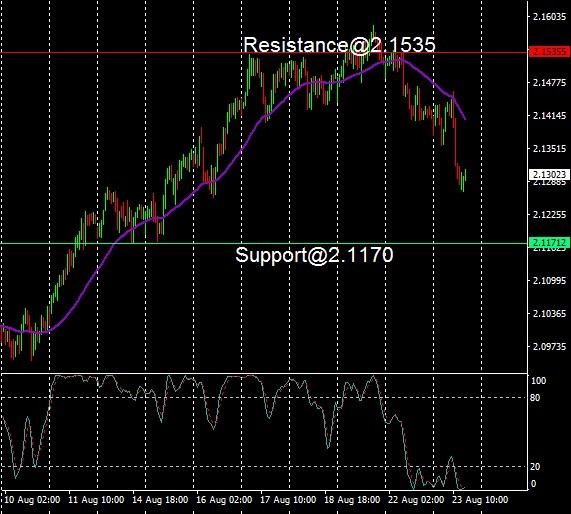
Technically, the GBP/NZD pair is descending after failing to break the resistance at 2.1535. The next major support is anticipated only near 2.1170. Additionally, the currency pair is trading below its 50-day moving average, while the stochastic indicator is in the bearish zone. Therefore, we anticipate the GBP/NZD pair to remain in a downtrend in the near term.
Disclaimer: Any financial trading analysis offered here is our opinion and is not intended as advice or direction for investors. We cannot guarantee the success of any trades made as a consequence of this article, and we encourage traders to incorporate a strong money management strategy to limit losses when they enter the markets. Please use this article as part of your own research before formulating strategies prior to trading.