
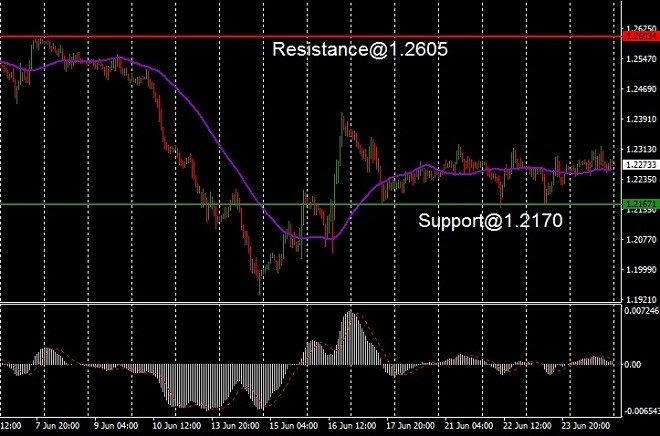
The pound traded in a narrow range against the greenback on Friday following the release of better-than-anticipated economic data from both the UK and the US. While US new home sales surpassed estimates, the UK’s retail sales decline was slightly better than feared by the market. Overall, the GBP/USD pair traded between 1.2265 and 1.2320.
According to the ONS, the UK’s retail sales declined 0.5% m-o-m in May, following an increase of 0.40% in the prior month, but a notch better than the 0.60% decrease anticipated by economists. Overall, the reported sales volumes stood 2.60% above the pre-pandemic February 2020 levels. The decline in sales volumes was led by food stores, which posted a drop of 1.60%. Reduced consumer spending in food stores can be attributed to surging food prices and the cost of living.
In the three months ended May 2022, compared with the prior three months, sales volumes declined 1.3%, and automotive fuel sales volumes grew by 1.10% in May. Non-food store sales volumes remained unaltered on a month-over-month basis. Clothing sales grew by 2.20% but were negated by a 2.30% decline in household goods, including furniture stores. Department stores posted a drop of 1.10%.
The percentage of retail sales online declined to 26.60% in May from 27.10% in April, but stayed considerably greater than the 19.70% recorded in the pre-pandemic February 2020 level.
According to the data published by the US Census Bureau, the country’s new home sales increased to 696,000 units in May, from 629,000 units in the prior month, and this delighted economists who were anticipating a drop in the new home sales to 590,000 units. The reported figure is 5.90% lower than the May 2021 estimate of 740,000 units.
While the median sales price of new houses sold was $449,000 in May, the average sales price stood at $511,400 during the same period. The number of new houses available for sale was 444,000 units in May, reflecting a supply of 7.70 months at the prevailing pace of sales.
According to the final data published by the University of Michigan, the consumer sentiment index inched lower to 50 in June, from 58.40 in the prior month, and two notches lower than the initial reading of 50.20. Economists did not anticipate any change in the preliminary reading.
The current economic conditions index fell to 53.80 in June, from 63.30 in May. Likewise, the index of consumer expectations was 47.50 in June, compared with 55.20 in the earlier month. Roughly 79% of consumers anticipated a bad scenario for the business environment, the highest level since 2009.
The better-than-anticipated economic data from both countries are expected to keep the GBP/USD pair range-bound in the short term.
Technically, the GBP/USD pair is rising after testing the support at 1.2160. The next resistance is anticipated only near 1.2605. Additionally, the currency pair is trading above its 50-day moving average, while the MACD indicator is showing a positive reading. Therefore, we are anticipating the currency pair to remain in an uptrend in the short term.
Disclaimer: Any financial trading analysis offered here is our opinion and is not intended as advice or direction for investors. We cannot guarantee the success of any trades made as a consequence of this article, and we encourage traders to incorporate a strong money management strategy to limit losses when they enter the markets. Please use this article as part of your own research before formulating strategies prior to trading.