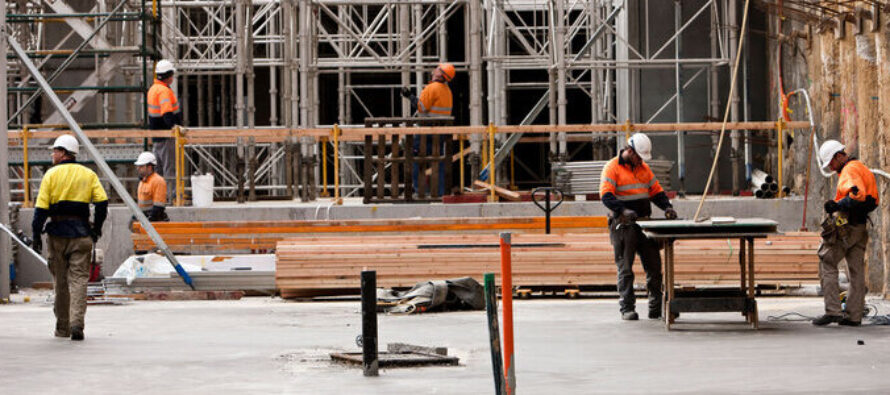
The Aussie declined against the greenback yesterday following the report of an unexpected decline in the construction work in the March 2022 quarter. But for the slightly lower-than-anticipated US durable goods orders, the AUD/USD pair would have recorded a steeper decline. There were no other major economic releases yesterday. Overall, the AUD/USD pair declined from a high of 0.7120 to a low of 0.7035.
According to the Australian Bureau of Statistics, construction work done fell by 0.90% in the March quarter, following a 0.60% growth in the previous quarter and disappointed economists who were anticipating a 1.10% rise for the reported period.
Overall, the value of work done was A$53.663 billion in the first quarter. The decline was led by building work done, which recorded a drop of 1.30% q-o-q to A$30.11 billion. Specifically, non-residential building work declined 1.80% in the March 2022 quarter. Similarly, new residential building work done dropped 0.90%.
Also, building work done was 1.10% lower compared with March 2021 quarter.
Likewise, engineering work done decreased 0.40% q-o-q to A$23.551 billion. Compared with March 2021 quarter, engineering work done stood 4.8% higher in March 2022 quarter.
According to the data published by the US Census Bureau, the country’s durable goods orders increased 0.40% m-o-m in April, following a rise of 1.10% in the prior month, but missed the 0.60% growth anticipated by economists.
In value terms, durable goods orders increased to $265.30 billion. Notably, the US durable goods orders have increased in six out of seven months.
Excluding transportation, fresh orders rose by 0.30%. The core durable goods orders, which exclude defense and other volatile sectors, grew by 0.30% in April, following a rise of 1.40% in March, but missed the 0.50% increase anticipated by economists. Transportation machinery, which recorded an increase in new orders following two successive months of declines, led the growth. Specifically, transportation equipment posted a growth of 0.60% (or $0.60 billion) to $86.70 billion.
Also, shipments of manufactured durable goods rose by 0.10% (or $0.30 billion) to $264.30 billion. This category has recorded an increase in eleven out of the past twelve months. In March, shipments of manufactured durable goods posted a 1.40% rise. The increase was led by primary metals, which recorded a growth of 0.90% (or $0.20 billion) to $20.90 billion. The primary metals sector has posted a growth in four out of the last five months.
Furthermore, inventories of manufactured durable goods rose by 0.80% (or $3.60 billion) to $479.40 billion. Transportation equipment reported an increase of 0.70% (or $1.10 billion) to $157 billion. Non-defense fresh orders for capital goods grew by 0.40% (or $0.40 billion) to $83.40 billion. Shipments rose by 0.60% (or $0.50 billion) to $78.40 billion.
The weak Australian construction work data is expected to keep the AUD/USD pair in a downtrend in the short term.
The historical price chart indicates that the AUD/USD pair is declining after forming a double top pattern at 0.7120. The next support is anticipated only near 0.6950. Additionally, the stochastics indicator is in the bearish zone. Therefore, we are anticipating the AUD/USD pair to remain in a downtrend in the short term.

Disclaimer: Any financial trading analysis offered here is our opinion and is not intended as advice or direction for investors. We cannot guarantee the success of any trades made as a consequence of this article, and we encourage traders to incorporate a strong money management strategy to limit losses when they enter the markets. Please use this article as part of your own research before formulating strategies prior to trading.