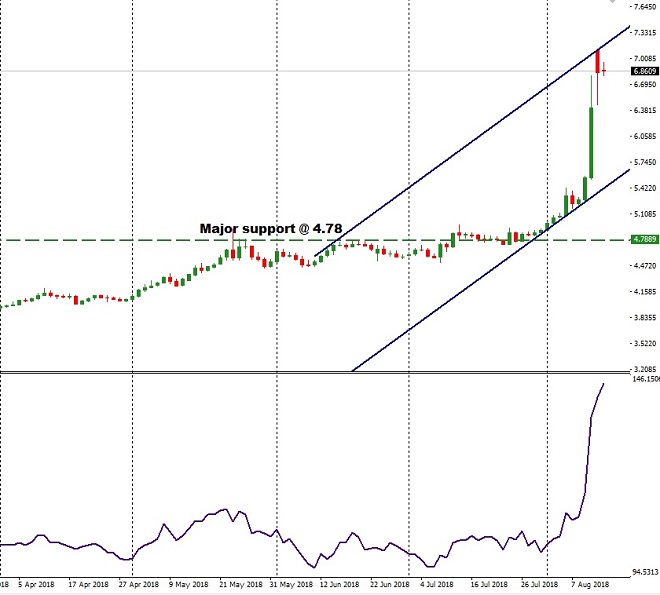
The Turkish lira hit a low of 7.24 yesterday before perking up to a level of 6.8480 at the time of writing this article. Its recovery was triggered by a series of announcements made by the country’s central bank to calm the situation and restore confidence among investors.
Political strain
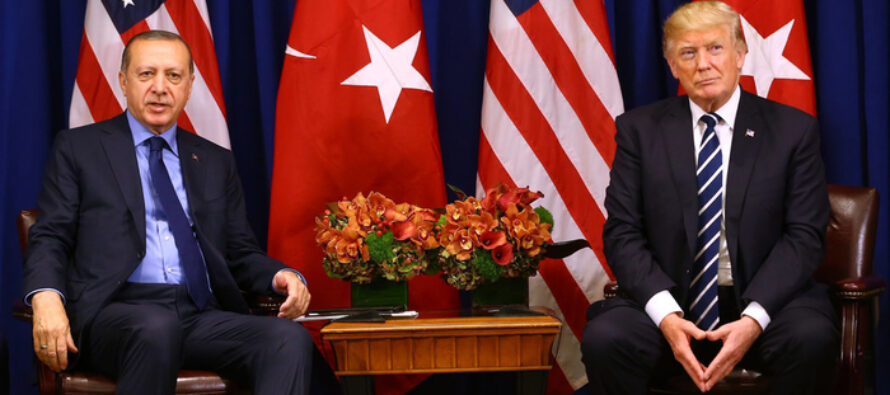
Although NATO allies, Turkey and the USA (USDTRY) have expressed contrasting views over a range of issues; including deviating interests in the Syrian Arab Republic, Turkey’s plans to acquire Russian defense systems, and most recently, the trial of Andrew Brunson, US evangelical pastor.
Elevating tensions saw Washington sanction two Turkish ministers and impose tariffs to the tune of 50% and 20% on steel and aluminum imports from Turkey. A Turkish delegation met with US counterparts last week to ease the brewing trade war, however, the situation remains at a deadlock.
Furthermore, President Erdogan’s influence on economic decisions, including frequent calls for lowering interest rates amidst high inflation, have created further concern among international lenders. These factors have culminated with a decline in the currency’s value.
Ongoing deflection
Turkey believes that the decline in the value of its lira is purely owed to very public political tensions with President Trump. The Finance Minister, Berat Albayrak, portrayed the lira’s decline as “an attack”; mirroring the opinion of President Erdogan. The President has also continued to voice his demand for low-interest rates, emphasizing that the economy is in good shape and that there is no financial crisis brewing. In an act of desperation, the government has taken legal action against 346 social media accounts, which have highlighted the continuing fall in the currency’s exchange rate.
However, neutral organizations outside Turkey’s border are concerned about the appointment of Erdogan’s son in law, Albayrak, as Finance Minister, and the influence this may be having over the present situation. Economists and lenders abroad believe that the Central Bank would be heavily influenced by this appointment.
Turkish Central Bank announcements
Albayrak has revealed that a plan is being prepared for the support of banks and the SMEs affected by the lira’s drop in value.
The Central Bank has stated that it will continue to monitor the market closely and take all actions necessary to maintain financial stability – including providing any necessary liquidity to the domestic banks. To soften the blow from sanctions, the Central Bank has also cut lira and forex reserve requirement for local banks.
Whilst the lira’s reserve requirement ratio has been cut by 250 basis points (all maturity brackets), the reserve requirement ratios for non-core Forex liabilities were reduced by 400 basis points (three-year maturity bracket). According to the Central Bank, these moves will result in additional liquidity of 10 billion lira, and such relaxations will also bring in $3 billion equivalent of gold liquidity in the system.
Impact on other currencies
Investors, analysts, banks, and other financial institutions are afraid that the lira’s sell-off could spread to financial markets across the world. The Euro, Mexican Peso, and the South African Rand are already declining due to this financial crisis. Konstantinos Anthis, head of research at ADS Securities has stated a warning that “clearly Turkey’s situation is another global risk.”
Disclaimer: Any financial trading analysis offered here is our opinion and is not intended as advice or direction for investors. We cannot guarantee the success of any trades made as a consequence of this article, and we encourage traders to incorporate a strong money management strategy to limit losses when they enter the markets. Please use this article as part of your own research before formulating strategies prior to trading.