
The British Pound rallied against the US dollar in the last week of June, after the statement from Mike Carney, Governor of the Bank of England, indicated the possibility of a rate hike in the months ahead. The Pound gained nearly 250 pips to record a high of 1.3028 against the Greenback. However, we expect the US dollar to recover the lost ground in the near future due to the reasons mentioned underneath.
According to Silvia Ardagna, an analyst at Goldman Sachs, the less hawkish monetary policy of the UK and lower than anticipated growth would keep the pound under pressure. Additionally, she points out that Brexit related issues will take time to be resolved, considering the weak government.
One of the main factors which determine the strength of a currency is the current account. The current account deficit narrowed towards the end of 2016. However, the latest data indicate that the improvement has come to a halt. The total trade deficit widened to £8.80 billion in Q1 2017, from £4.8 billion in Q4 2016.
The first major economic data reported on Tuesday disappointed the market. A report from IHS Markit indicated that the UK manufacturing PMI has declined to a three-month low of 54.3 in June, versus analysts’ expectations of 56.4, and below the previous month’s downwardly revised reading of 56.3. The reading shows that economists had overestimated the strength of the UK’s manufacturing sector.
In the US, the Institute of Supply Management reported an increase in the PMI (Purchase Managers Index) reading to 57.8 in June, up from 54.9 last month. The reading was also higher than analysts’ estimates of 55. The leading indicator of economic health is based on a survey of over 400 purchasing managers in the US. Thus, poor manufacturing data and a widened deficit is expected to turn the Pound weak against the US dollar.
The GBPUSD pair faces resistance at 1.2990. Lack of buying pressure is indicated by the momentum indicator, which is forming lower highs. On the downside, the next major support exists at 1.2770. Thus, we can expect a downswing in the currency pair.
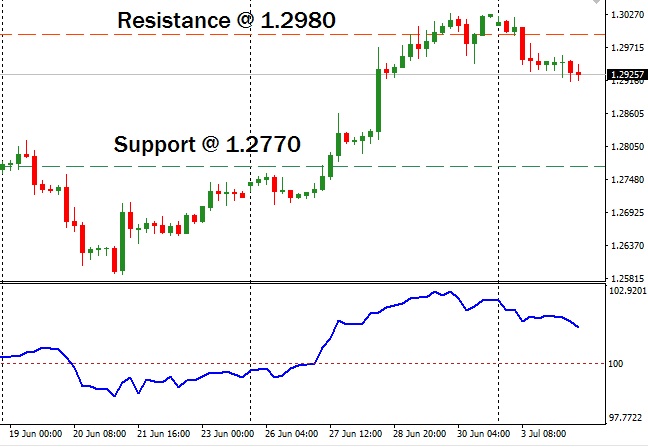
A short position in the Forex market is what we prefer as of now. The preferred entry and exit levels are 1.2960 and 1.2780. To avoid large losses, a stop-loss order would be placed above 1.3040.
On the basis of the forecasted downtrend, we are willing to invest in a put option when the currency pair trades near 1.2960 in the OTC market. Additionally, a date around July 13th would be selected for the expiry of the option.
Disclaimer: The trading analysis offered here is our opinion. It is not provided as trading advice, merely an indication of our trading plan. We cannot guarantee success and we encourage traders to incorporate a strong money management strategy to limit losses. Please use this article as part of your own research before formulating strategies prior to trading.