Hacking digital wallets seems to be the most profitable illegal activity. Smart hackers can easily cover up the trail while earning millions of dollars from the comfort of their homes. Unless the stolen coins are routed to an exchange immediately, it will be quite difficult to trace and bring the hacker to justice. That may very well happen with the $533 million crypto coin hacking incident that was revealed on Thursday by Coincheck, an unregulated crypto exchange based in Japan.
Coincheck suspended withdrawals, deposits, and trading in the early hours of Thursday. There were rumors that the exchange had lost $500 million worth of NEM (XEM) coins, much higher than $400 million lost by Mt.Gox in 2014. The matter was later confirmed by Wakata Koichi Yoshihiro, Coincheck exchange’s president, and Yusuke Otsuka, the COO, in a press conference held at 23.30 JST. Read more here.
Obviously, the cryptocurrency market reacted negatively to the news, with Bitcoin, Ripple, and Ethereum falling to a low of $10,185, $1.06, and $978, respectively. However, all the coins bounced back on the weekend. We are expecting the major crypto coins to turn volatile as more news related to the hacking incident comes out.
Bitcoin
Weiss Ratings is a US-based independent provider of ratings for banks and insurance industries. It currently covers 55,000 institutions and investments. Unlike other rating agencies such as Moody’s, Fitch, and S&P, Weiss does not accept any kind of payment from the organizations it rates.
The rating agency had recently announced that it will issue letter grade ratings to Bitcoin and other cryptocurrencies, the first of its kind by any rating agency. The ratings were released last week and much to the disappointment of crypto enthusiasts, Weiss had given only a C+ rating to Bitcoin. While Ethereum fared better with a rating of B, Ripple got a much worse rating of C.
Ethereum
Weiss Rating agency has given a B rating to Ethereum. That keeps the crypto coin above the psychological level of $1000, despite the coin hack incident. As the number of DApps (decentralized applications) on the Ethereum network continues to grow, the coin is expected to appreciate further. One of the major issues faced by Ethereum was scalability.
Even though the Ethereum network can process as many as 20 transactions per second, more than six times that of the Bitcoin network, still, it is quite low compared to 24,000 transactions that can be processed per second by the Visa network. In this regard, Vitalik Buterin, the developer of Ethereum announced on Friday that part one of Ethereum’s Sharding roadmap is almost completed.
Ripple
Two weeks before, Ripple signed an agreement with MoneyGram for the latter to sign its payment network. Last week, IDT Corporation, a publicly-traded New Jersey-based telecommunications provider, and MercuryFX, a firm offering discounted currency exchange rates, have signed an agreed to test the xRapid platform of Ripple.
Both IDT and MercuryFX handle hundreds of millions of transactions every year. The xRapid platform allows institutions to save on the cost of accessing and providing liquidity to their clients. Despite adding two more credible use cases, Ripple coin remains weak in the chart. It is currently trading at about $1.15. Read more here.
NEO
NEO (NEO) is the first ever open source blockchain network from China. Users will be able to register, trade and circulate multiple types of assets on NEO’s blockchain, which was formerly known as Antshares. Notably, smart contracts can be developed using mainstream programming languages such as C#, Java, etc. There is no need to learn a separate language as in the case of Ethereum.
Furthermore, the NEO network can handle up to 1000 transactions per second. NEO’s Universal Lightweight Virtual Machine (NeoVM) offers a high degree of certainty, concurrency, and scalability. It is also hard-fork proof due to the dBFT consensus mechanism it employs. Theoretically, it is also hack-proof as the network is based on an anti-quantum cryptography mechanism, known as NeoQS. Therefore, crypto specialists anticipate a huge increase in the real-world use case of this network. The coin has undergone a short-term correction after hitting a high of about $198 and is currently trading at $136. Read more here.
Our Forex Trading Plan
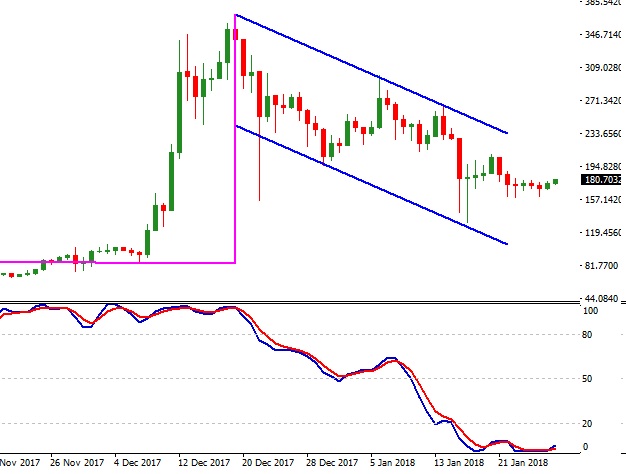
 Litecoin. Litecoin is forming a bullish flag pattern on the chart, as shown below. The stochastic indicator is also rising from the oversold territory. Thus, we can expect the LTCUSD pair to begin an uptrend soon.
Based on the expectation, we are considering opening a long position near 180. We would look forward to exit near $250. To minimize risk, we will place a stop-loss order below 120.
Our Binary Options Trading Plan
 Ripple. Despite signing two agreements last week, Ripple coin remains weak. The negative reading of the MACD histogram also confirms the bearishness in the XRPUSD pair. Thus, it would be prudent to remain short to the counter.
We may position ourselves to gain from a deeper decline by investing in a put option. The contract should be valid for one week and the Ripple coin should be trading near $1.25 in any of the major cryptocurrency exchanges.

Disclaimer: Any financial trading analysis offered here is our opinion and is not intended as advice or direction for investors. We cannot guarantee the success of any trades made as a consequence of this article, and we encourage traders to incorporate a strong money management strategy to limit losses when they enter the markets. Please use this article as part of your own research before formulating strategies prior to trading.