Electric car manufacturer Tesla, Inc. (NASDAQ: TSLA) reported a swing to a loss in the fiscal 2017 third-quarter, compared with a net profit in the corresponding quarter of 2016. The quarterly net loss also missed analysts’ estimates. Investors punished the stock for bad performance and took it to a low of about $291. However, in the past few trading sessions, the stock has bounced back to a level of $323. We anticipate a downtrend to begin soon due to the reasons given below.
For the third quarter, the company reported revenues of $2.985 billion, an increase from $2.298 billion in the year-ago period, and exceeded analysts’ estimates of $2.95 billion. Tesla recorded a swing to a net loss of $619.38 million, or $3.70 per share in Q3 2017, compared with a net profit of $21.88 million, or $0.14 per share, in 3Q16.
Excluding stock-based compensation expenses and losses related to the SolarCity acquisition, the third-quarter non-GAAP net loss was $488.498 million, or $2.92 per share, compared with a non-GAAP net profit of $111.421 million, or $0.71 per share in the year-ago period. Analysts had expected the company to post a net loss of $2.29 per share.
The company delivered 26,137 vehicles during the quarter. The figure includes 25,915 Model S and Model X vehicles. Tesla also delivered 222 Model 3 vehicles during the quarter.
Going ahead, the company now expects to manufacture about 5,000 units of the Model 3 sedan every week, beginning late in the first quarter of 2018. Tesla attributed the delay in ramping up production to issues related to the battery-pack assembly in one of its factories. However, the market was absolutely unimpressed by the news and that pushed the share price lower.
In early 2016, Elon Musk, CEO of Tesla, had stated the company would manufacture between 3,800 to 7,600 vehicles a week in the second half of 2017. At the end of the July quarter, Musk guided the production outlook to about 5,000 vehicles a week by the end of December. So, another postponement has resulted in a credibility problem for the company. Analysts believe that Tesla would hardly reach 10% of its production target set in 2016.
Tesla announced that it would be trimming production of Model X and Model S by about 10% and employ additional resources towards Model 3. That would result in a decline in inventories. Further, the company expects Q4 non-GAAP automotive gross margin to decline to about 15%.
A delay in increasing the production of Model 3 also raises concerns about Tesla’s debt level. During the past two quarters, the company has spent about $2.4 billion, which is more than what it had spent in the previous six quarters combined. The company has already burnt most of the $3.2 billion raised in March through selling new equity and convertible debt.
Thus, since the beginning of 2017, the net debt has almost tripled to $3.36 billion. The company has about $3.5 billion in cash at the end of the third quarter. Capital expenditures are expected to the tune of about $1 billion in the current quarter, mainly on types of machinery related to Model 3. Analysts and investors are therefore worried about the rate at which the company burns cash.
Apart from manufacturing-related headwinds, the company also faces issues with the autoworkers union over the recent dismissal of several hundred employees. Thus, a swing to Q3 loss, postponement of production targets of the Model 3, and rising debt is expected to keep the stock bearish in the short-term.
The stock is unable to stay above the 50-period moving average and has started declining after facing resistance at 327. The momentum indicator also confirms the bearishness in the stock. Thus, we can expect a continuation of the downtrend.
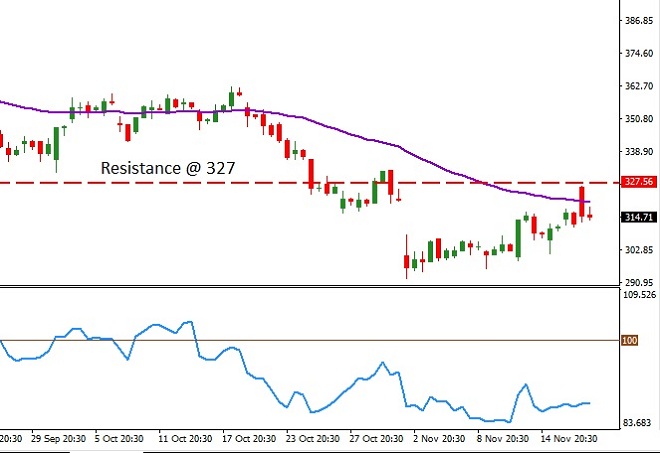
To benefit from the decline, we wish to buy a put option from any of the reputed binary brokers listed here. The option should be active for a week and the trade entry is planned near $314.
Disclaimer: Any financial trading analysis offered here is our opinion and is not intended as advice or direction for investors. We cannot guarantee the success of any trades made as a consequence of this article, and we encourage traders to incorporate a strong money management strategy to limit losses when they enter the markets. Please use this article as part of your own research before formulating strategies prior to trading.