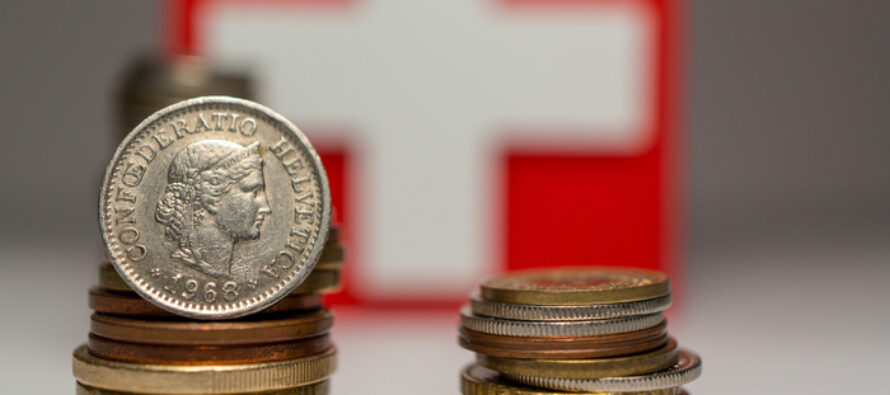
The Aussie turned weak at the beginning of this year after the economy started slowing in late 2017. On the contrary, the Swiss economy is all set to record solid growth in 2018, after picking up the pace at the end of 2017. In February, the Aussie regained a portion of the lost ground against the Swiss franc, when the iron ore rallied to a 10-month high of $79.95 per ton in February. The uptrend was also aided by coking coal’s near eight-month high price of $243. However, the uptrend did not last long. Due to the economic slowdown, the Aussie was unable to consolidate against the Swiss franc. We anticipate the AUDCHF pair, which is trading near the nine-month low of 0.7270, to move down further due to the reasons given below.
Last week, the State Secretariat for Economic Affairs (SECO) published its forecast for Switzerland’s economic development based on assumptions about the international economy and on monetary developments. The report expects the economy to grow at 2.4% in 2018 and 2.0% in 2019. The growth rate expectations are 0.1% higher than the previous forecasts issued in December 2017. Last year, the Swiss economy grew 1.9% on a y-o-y basis.
The KOF index, a leading indicator, which reflects expectations for the next six months, rose to an overwhelmingly positive 108 points in February. The jobless rate stood at 3% in January, while the non-farm payrolls were up 0.8% in the fourth quarter. The industrial orders increased 20% y-o-y in the fourth quarter. Likewise, the tourism industry is bustling with activity. Therefore, the Swiss franc is expected to remain strong. The Aussie dollar, however, is expected to decline due to the underlying weakness in the economy and a sharp fall in the price of iron ore.
Iron ore prices tumbled to about $65 per ton in March, from about $80 per ton in the previous month. The near 20% m-o-m decline in the price of iron ore was mainly due to softness in Chinese imports. Vivek Dhar, mining and energy commodities analyst at the Commonwealth Bank, does not expect any recovery in the price of iron ore in the months ahead. Both the construction sector and exports have slowed down considerably in recent months. The country recorded a GDP growth rate of 2.4% in 2017, down from 2.9% in the earlier year. Analysts were expecting a GDP growth rate of at least 2.5%.
Gareth Aird, Senior Economist at the Commonwealth Bank, has pointed out that productivity growth has turned weak. Elaborating his stance, Aird said “GDP per hour worked, a measure of productivity, actually fell by 0.1% in 2017. Australia appears to be in a low productivity phase.” Therefore, the AUDCHF pair is fundamentally expected to decline in the week ahead.
Technically, the AUDCHF pair has broken the support at 0.7370. The next major support is only at 0.7110. The negative reading of the MACD histogram also confirms weakness in the currency pair. Therefore, we can expect the AUDCHF pair to move down further.

Using one of our Forex trading accounts, we may go short in the Forex pair near 0.7340, with a stop-loss order above 0.7460. We would wind up the short position when the currency pair drops to about 0.7130.
Simultaneously, we may also invest in a put option contract to gain from the AUDCHF pair’s decline. The option contract may be bought when the pair trades near 0.7340. Furthermore, a date around April 5th would be chosen for the contract’s expiry.
Disclaimer: Any financial trading analysis offered here is our opinion and is not intended as advice or direction for investors. We cannot guarantee the success of any trades made as a consequence of this article, and we encourage traders to incorporate a strong money management strategy to limit losses when they enter the markets. Please use this article as part of your own research before formulating strategies prior to trading.