
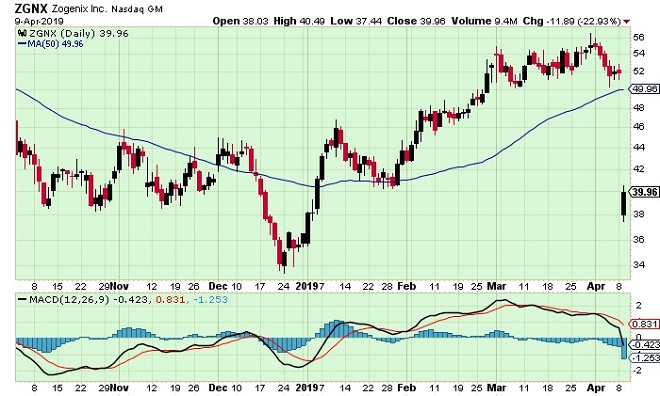
The US Food and Drug Administration declined to thoroughly examine the marketing proposal for the Dravet syndrome seizures drug developed by Zogenix, Inc. (Nasdaq: ZGNX). During an initial evaluation, the FDA found that the request was not adequate for a meaningful assessment. Following the announcement, Zogenix shares plunged by 22.93% yesterday to close at $39.96.
Zogenix, an international pharmaceutical company with headquarters in Emeryville, California, revealed that the FDA issued a “refuse to file” letter on its drug candidate, hydrochloride fenfluramine (Fintepla). Notably, such correspondences are not a refusal of a drug.
However, they notify pharmaceutical companies that the FDA’s initial evaluation of a proposal has identified inadequacies and the letter informs them what has to be done to resolve the problems.
Two issues were raised by the FDA, Zogenix asserts. First, there were still some non-clinical studies that Zogenix did not present for the FDA to evaluate the drug’s chronic administration. The second issue is the wrong version of the clinical dataset which halted a thorough review by the regulator. Zogenix said the FDA did not demand extra clinical effectiveness data or extensive trials to illustrate the safety of the drug.
Zogenix has formulated its medicine to cure Dravet syndrome seizures, a rare form of epilepsy that manifests in early childhood and affects approximately 1 in 18,500 individuals.
The FDA forwarded the Refusal to File (RTF) as it ascertained that the New Drug Application (NDA), which was tabled on February 5th, 2019, did not have all the requisite data to perform a detailed evaluation.
Zogenix’s pharmaceutical uses a minimal dose of liquid fenfluramine that was previously used in the obesity drug mix. The compound is the “fen” portion of the “fen-phen” type drug which was taken out of the US market in the 1990s because of risks related to the heart. Zogenix did not mention such symptoms in clinical studies.
Before introducing the drug again, Zogenix will have to obtain approval for marketing from the FDA because of the “Refusal to File” letter. Current Dravet syndrome medications, affecting a projected 20,000 US patients, are restricted to a combo of anti-seizure drugs and emergency medicines.
In a note to clients, Stifel analyst Paul Matteis opines that the FDA’s reluctance to file letters is “legitimately puzzling.” He highlights that over 200 patients with Dravet have undergone treatment with the Zogenix drug for a maximum of one year and the company is currently carrying out an isolated study in another form of epilepsy, Lennox-Gastaut syndrome.
Matteis pointed out that the research comprises an open-label extension study and “you’d think that the FDA would have asked for, or been comfortable with, prior preclinical toxicology studies before signing off on the conduct of extension trials.”
Zogenix applied for FDA approval under 505(b)2 guidelines, which permits a company to depend on data from earlier academics on safety and effectiveness. But Matteis pointed out that the scientific data is from the 1960s and seventies. If Zogenix wants to undertake more preclinical toxicology studies, it can postpone applying by 12 to 15 months. However, Matteis considers the FDA endorsement of the drug as “very probable,” based on the safety and effectiveness data of the drug candidate from earlier clinical studies, in addition to the few alternative treatment options for Dravet patients.
If Zogenix can get its drug approved, it would be competing with a GW Pharmaceuticals drug (NASDAQ: GWPH) cannabidiol (Epidiolex), which in 2018 became the first Dravet syndrome therapy endorsed by the FDA. Zogenix said that it would ask for expert advice from the FDA immediately in order to respond to the disapproval issues.
The FDA’s rejection of Zogenix’s application will be regarded as a temporary setback by the market.
Technically, the stock has closed below its 50-day moving average, in addition to the formation of a bearish gap. The MACD indicator also has a negative reading. As a result, we can expect the stock to move down in the short-term.
Disclaimer: Any financial trading analysis offered here is our opinion and is not intended as advice or direction for investors. We cannot guarantee the success of any trades made as a consequence of this article, and we encourage traders to incorporate a strong money management strategy to limit losses when they enter the markets. Please use this article as part of your own research before formulating strategies prior to trading.