In 2018, Volkswagen AG (VOW3) posted another annual sales record as fresh SUV models significantly boosted deliveries and the German automaker managed to improve its shares in China as the automotive market went downhill for the first time in years. The stock, which closed at $162.41, down $2.01 or 1.22% on Friday, is expected to react positively to the report in the days ahead.
Volkswagen shrugs off tainted past to post record deliveries
The Wolfsburg-based manufacturer of Volkswagen, Porsche, Audi, Skoda, and several other popular brand cars sold 10.83 million vehicles in 2018, outperforming its 2017 record of 10.74 million vehicles by a margin of 0.9%. Notably, Skoda, Seat, Porsche, and Lamborghini all set new delivery records in 2018. The only underperformer was the high-end luxury vehicle Audi, whose sales declined by 3.5%.
Marketing head, Christian Dahlheim, applauded the increase in sales in a worldwide passenger car market that shrank by 1.2% percent last year by calling the performance “a great result.”
GM realized strong sales growth in Eastern Europe, Russia, and South America. In China, the company recorded 0.5% y-o-y in sales growth. However, overall market shares declined in the South Asian nation.
The shares of sports utility vehicles in total sales of Volkswagen increased to 23.2% last year, from 12.6% in 2014. It is a notable figure because SUVs command better prices and profit margins than traditional vehicles such as hatchbacks and sedans. Volkswagen generated 43% of its overall revenue from North America. The company sold roughly 50,000 hybrid and electric cars, an increase of 13% compared with 2017.
VW brand sales chief, Juergen Stackmann, said: “2018 was marked by significant uncertainty in some regions, especially in the second half.”
He further stated that the launch of new products enabled the company to offset the uncertainty. Each year, the Wolfsburg-based group is locked in a tight race with Toyota and Renault-Nissan-Mitsubishi for the title of the world’s top-selling carmaker. The rivals have yet to reveal their 2018 figures.
In 2017, Volkswagen competed with the Renault-Nissan-Mitsubishi partnership as the world’s largest automaker. The coalition claimed that it was number 1 with 10.6 million cars sold and said that by including trucks into the equation, Volkswagen grossly inflated its number. The Alliance will declare figures for 2018 later this month.
Toyota, which became Number 1 in 2016 by dethroning Volkswagen, has projected sales of 10.55 million in 2018 but is yet to release the final count. In 2015, Volkswagen hit a bad patch when they acknowledged they had defrauded emission tests on millions of diesel cars. But while it remains engulfed in expensive legal problems, customers have remained loyal to the group.
The company no longer designates sales volume records as its primary business objective. Wanting to take over the top position in the worldwide sales race used to be the goal of former CEO Martin Winterkorn, who quit his job in 2015 following the company’s installation of cheating software in cars to escape the US emission tests. So far, the company has shelled out more than EUR 27 billion (over EUR 31 billion) in the form of fines and settlements.
One of the most significant setbacks last year actually originated from the more stringent WLTP emission tests of the European Union, enacted by the “diesel gate” scandal. Dahlheim said that the company managed to overcome inefficiencies in the certification of cars according to the recent carbon emission rules that came into force on September 1st in Europe. These challenges affected sales in Europe in the months that followed.
Regarding the record sales, Christian Dahlheim, head of Volkswagen group sales, said: “We are very pleased about this great result. Especially in the second half, things were not easy for us.”
VW further mentioned that it looks to the future “with optimism” but cautioned about challenges ahead. In this regard, Dahlheim said, “In view of volatile geopolitical developments, our business will face an equally strong headwind in 2019.”
In another news, Volkswagen AG and Ford Motor Co (F.N) intends to disclose a deeper partnership this week that goes beyond cooperating in commercial vehicles in a move meant to save the automakers billions of dollars as they develop new technologies. Ford and Volkswagen have been researching greater cooperation as trade tensions have put carmakers under pressure to reexamine where they manufacture vehicles for Europe, China, and the United States, and as software firms get ready to introduce their own autonomous cars.
The extent of the alliance is still under consideration as reports indicate, and negotiations about cooperation in the area of autonomous and electric cars continue.
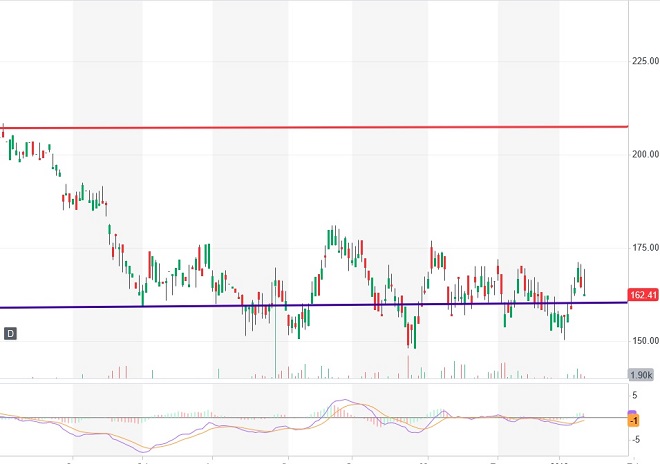
The price chart indicates consolidation of the stock at 162 levels. Furthermore, the MACD indicator has crossed above the zero reading. Therefore, we can expect the stock to turn bullish in the week ahead.
Disclaimer: Any financial trading analysis offered here is our opinion and is not intended as advice or direction for investors. We cannot guarantee the success of any trades made as a consequence of this article, and we encourage traders to incorporate a strong money management strategy to limit losses when they enter the markets. Please use this article as part of your own research before formulating strategies prior to trading.