In a glaring display of the complex manner in which the world economies are inter-connected, Toyota Motor Corp (Tokyo Stock Exchange: 7203. T-JP, NYSE: TM) announced its decision to extend earlier announced production cuts this month, primarily due to semiconductor chip shortage.
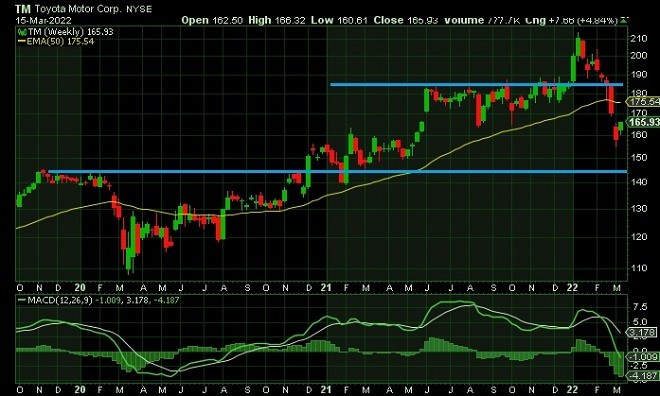
The more problematic factor is that the ongoing Russia-Ukraine war could intensify the semiconductor chip shortage, a statement that seems bizarre to uninformed individuals. The stock closed at $165.93, up $4.84 or 3.00% from the prior close.
Lasers employed in chip production require semiconductor quality neon gas. Notably, 90% of the US chip-grade neon gas is supplied by Ukrainian companies. Two of those companies, accounting for 50% of the global chip grade neon supplies, have stopped production last week. Interestingly, neon gas, a secondary product generated during the production of steel, is bought from Russia and purified by Ukrainian firms. The war has brought the operations to a standstill. This has amplified concerns over the prevailing chip shortage issue.
Taking the prevailing chip shortage into account, Toyota has announced further production cuts this month. Specifically, to deal with “components scarcity arising from the revival of COVID-19 infections,” Toyota was forced to implement “changes” to its local manufacture of automobiles.
Beginning March 22, the company intends to halt production on a single line in one of its factories for eight days (barring weekends). The plan comes on top of the decision to halt domestic output at two sites last month.
Notably, just five days ago, the Japanese automaker had announced a production cut of up to 20% for the quarter ending June. The company believes that it will decrease the stress on suppliers.
The automotive sector continues to be impacted by the worldwide scarcity of components, particularly semiconductors. The latest announcement will affect the production of Noah and Voxy minivans totaling roughly 14,000.
On Monday, Toyota, which has a joint venture with FAW Group in China’s Changchun city, announced a halt to production due to new prohibitions enforced to contain the spread of COVID-19 in the country.
Despite the decision to slash production, Toyota continues to maintain its annual production target of 8.50 million vehicles for 2022. The worldwide chip shortage has affected not only automakers but also smartphone and other consumer electronic goods manufacturers.
Notably, in August 2021, Toyota had cautioned that its global vehicle production would be reduced by 40% in September, primarily due to chip shortage. In October, French automobile maker Renault had forecast a decline in vehicle production by 300,000 in 2021.
The Russia-Ukraine war and disruption in neon gas supply is now an added worry to automobile manufacturers. Currently, the chip manufacturers have an adequate stockpile of neon gas. So, there is no issue as of now, but prolonged war could intensify chip supply issues.
Volkswagen Group has revealed that the number of cars it sold last year was 2 million less than what was planned earlier. The decline in sales was due to chip shortage. The company has cautioned that prevailing supply chain issues, surging commodity prices, and the Russia-Ukraine war could affect its growth this year.
Interestingly, Toyota, Volkswagen, and other automobile manufacturers have already terminated production in Russia.
The production cut announcement is likely to keep the stock of Toyota range-bound with a slight bearish bias in the future.
The historical price chart reveals that the stock of Toyota has broken the support at 180. The next major support is expected only near 150. Additionally, the stock is trading below its 50-day moving average, while the MACD indicator has a negative reading. Therefore, we expect the stock to stay in a downtrend in the short term.
Disclaimer: Any financial trading analysis offered here is our opinion and is not intended as advice or direction for investors. We cannot guarantee the success of any trades made as a consequence of this article, and we encourage traders to incorporate a strong money management strategy to limit losses when they enter the markets. Please use this article as part of your own research before formulating strategies prior to trading.