
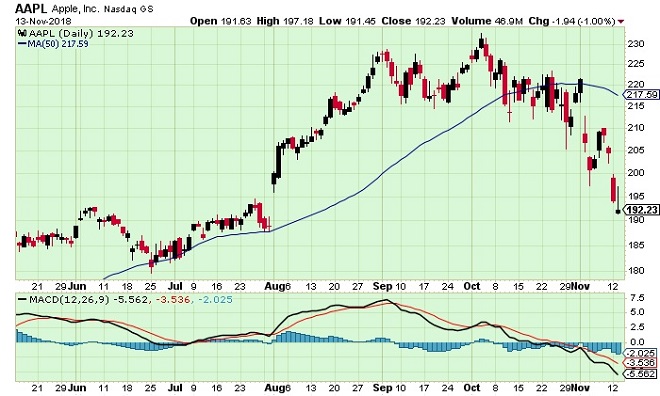
Shares of Apple Inc. (NASDAQ: AAPL) declined to a three 1/2-month low, as a revenue and net profit warning from Lumentum (NASDAQ: LITE), an optical equipment supplier, seem to be confirming investor concerns about falling iPhone demand. Foxconn Technology Group, which is another major sub-contractor of Apple, posted an 18.3% increase in third-quarter net profit from the corresponding period last year. The rise in profit, however, arrives out of a low base. Following Foxconn’s results, Apple’s stock closed at $192.23, which represents nearly a 17% decline from its October the 3rd record close of $232.07.
Lumentum, Foxconn & Japan Display issues earnings warning
Lumentum Holdings Inc. shares hit a new 52-week low of $37 earlier this week after the company disclosed that it “recently received a request from one of our largest industrial and consumer customers for laser diodes for 3D sensing to materially reduce shipments” during its September-December quarter.
Based on the received message, Lumentum revised its adjusted EPS (earnings per share) outlook range for the second quarter to $1.15 – $1.34 from $1.60 – $1.75 and revenue guidance range to $335 million – $355 million from $405 million – $430 million. Notably, the earlier guidance was issued less than two weeks before, when Lumentum posted its first-quarter results.
Similar to Lumentum, Taiwan-based Foxconn yesterday reported a net profit of 24.9 billion New Taiwan dollars (~$805 million) for the quarter ended September 30. The reported earnings were lower than the NT$29.3 billion anticipated by FactSet. In the year-ago period, the company’s net profit was NT$21.0 billion.
Kylie Huang, an analyst at Daiwa Capital Markets based in Taiwan, pointed out that in the same period a year ago, Foxconn faced a production delay in Apple’s iPhone X.
During the recent quarter, revenues rose 27.5% to NT$1.38 trillion from NT$1.08 trillion reported last year.
A look at the 10-K annual report filing of Lumentum with the Securities and Exchange Commission clearly shows that its largest customer is Apple, accounting for nearly 1/3rd (or 30%) of total revenues for fiscal 2018 that ended June the 30th. In the fiscal 2016 and 2017, Apple accounted for less than 10% of Lumentum’s income.
In the latest quarterly filing (10-Q) earlier this month, Lumentum has mentioned that “Customer A” accounted for 30.5% of its total revenue.
Commenting on the downward revision of earnings guidance, Wells Fargo analyst Aaron Rakers opined that Apple was the primary reason for Lumentum to trim its earnings view. In a note to clients, Rakers has mentioned: “We think investors could consider Lumentum’s updated guide as reflecting as much as a 30% cut in Apple orders.”
Similarly, D.A. Davidson’s Mark Kellerher said: “we believe Apple was the client that asked for reduced supply.” He further opined that a large inventory and a decline in market share or at least less demand for iPhones are the main reason for Apple’s request for reduced supply. Considering the sudden revision of guidance issued just 12 days before, Kellerher feels that “slower end-user demand for iPhones is the most probable explanation.”
Foxconn, previously known as Hon Hai Precision Industry Co., the world’s largest contract electronics maker, popularly known for assembling Apple’s iPhones in its Chinese factory, depends on Apple for about half of its revenue. Other than iPhone X, Foxconn is also given the task of assembling the iPhone 8 Plus this year. It appears that Foxconn will continue to depend on Apple for growth in 2018, which implies that things are not looking rosy.
Another Apple supplier, Japan Display Inc., has also slashed its earnings forecast for the upcoming quarter. On Monday, the screen maker, Japan Display Inc., reported its sixth consecutive quarterly operating loss and lowered its outlook for the fiscal year on weak demand from smartphone manufacturers. The company stated that it anticipates full-year sales to increase between 5% and 15%, versus an earlier forecast for a 10% to 20% growth. Additionally, Japan Display expects an annual operating margin of 1% to 2% rather than a prior outlook of 2% – 3%.
Following the release of Apple’s Q4 results, there were concerns about slowing iPhone demand as the company issued a downbeat 1Q19 view and also stated that it would no longer publish volume sales details for iPhones.
China-made merchandise such as the iPhones are in danger of confronting U.S. taxes, as President Trump has warned of imposing tariffs on more Chinese merchandise. Companies like Apple also face the threat of reprisal by China should two-sided trade tensions spread. The above facts indicate that Apple’s stock will remain bearish in the short-term.
Technically, the stock has broken its 50-day moving average. Furthermore, the MACD indicator is declining in the bearish zone. As a result, we can expect Apple to remain weak in the days ahead.
Disclaimer: Any financial trading analysis offered here is our opinion and is not intended as advice or direction for investors. We cannot guarantee the success of any trades made as a consequence of this article, and we encourage traders to incorporate a strong money management strategy to limit losses when they enter the markets. Please use this article as part of your own research before formulating strategies prior to trading.