The shares of Thomas Cook Group plc (OTC: TCKGY, LSE: TCG.L) got suspended from trading on Monday after the most popular and oldest brand in world travel filed for bankruptcy – terminating all operations related to bookings, vacations, and flights.
The company has entered into compulsory liquidation after last-minute rescue talks did not succeed. The shut-down of the 178-year old travel giant has left several thousands of tourists stranded, with the British government forced to undertake the largest peacetime repatriation of more than 150,000 UK customers. The aviation regulator, along with the UK government, is now working out how to bring back the people under a rescue plan code-named Operation Matterhorn.
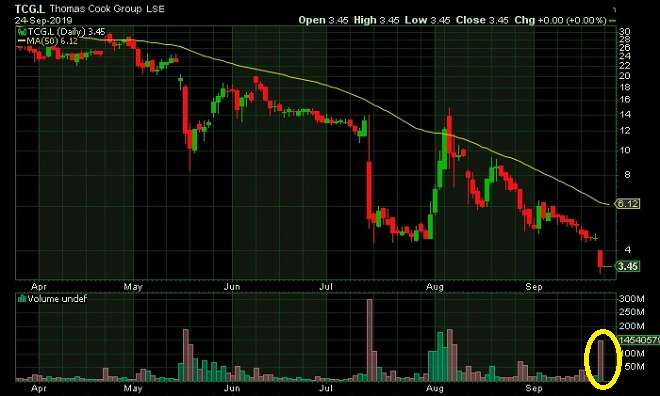
The UK foreign secretary Dominic Raab has stated that a necessary contingency plan is in place to take care of the stranded tourists. The stock was last traded for 3.45p in the London Stock Exchange. In the OTC market, the stock was last sold for $0.1060.
After several months of negotiation, a $1.10 billion rescue plan was created under the leadership of Fosun Tourism Group. The program included a fresh capital injection and swapping of debt for shares, making Fosun the majority stakeholder in the company.
Creditors would have gained control of the airline division. However, the negotiations collapsed after the UK-headquartered travel giant failed to secure an additional $250 million (£200 million) line of credit requested by large banks which were part of the deal.
Fosun explained the complexity that led to the collapse of the company: “Fosun is disappointed that Thomas Cook Group has not been able to find a viable solution for its proposed recapitalization with other affiliates, core lending banks, senior noteholders, and additional involved parties. Fosun confirms that its position remained unchanged throughout the process, but unfortunately other factors have changed.”
Regarding the failed negotiations to rescue the company, Thomas Cook issued the following statement: “Despite considerable efforts, those discussions have not resulted in an agreement between the company’s stakeholders and proposed new money providers. The company’s board has therefore concluded that it had no choice but to take steps to enter into compulsory liquidation with immediate effect.”
The company’s CEO, Peter Fankhauser also explained that management did their best to save the company from liquidation. Fankhauser said: “Despite huge efforts over a number of months, and further intense negotiations in recent days we have not been able to secure a deal to save our business. I know that this outcome will be devastating to many people and will cause a lot of anxiety, stress, and disruption.”
Many investors and the general public had anticipated support from the UK government. The company generated almost 75% of its revenue from tour operations, i.e., $6.8 billion (£5.4 billion) from outside the UK. Being a pan-European business has made it difficult to get the much-needed backing from the UK government.
On Monday, British Prime Minister Boris Johnson confirmed that Thomas Cook had contacted the government for $187 million (£150 million) in financing on an urgent basis. However, the UK government refused to back the company. Prime Minister Boris Johnson justified the decision by saying, “Clearly that is a lot of taxpayers’ money and sets up a moral hazard in the case of future commercial difficulties that companies face.”
Following liquidation, 21,000 full-time employees in 16 countries would lose their jobs. Thomas Cook also has 116 aircraft operated by several airlines. On Monday, the company submitted requisite documents to the UK High Court for liquidation proceedings.
As travel businesses are highly regulated in the UK and Europe, customers will get back their money even if enterprises go bankrupt. Notably, little more than a year ago the company was worth £1.85 billion ($2.3 billion).
The recent financial report indicated that Thomas Cook had a net debt of £1.25 billion and a total loss of £1.46 billion in the first half ended March 2019. The travel enterprise blamed a decline in demand for winter holidays and Brexit uncertainty as prime reasons for the losses. In addition, high fuel and hotel costs also weighed on the performance.
The inventor of the holiday package will now come under the control of administrators who will initiate the proceedings to pay off creditors. A sum of 1.9 billion pounds ($2.4 billion) is owed to creditors as per the latest financial report.
Global consultancy firm Alix Partners will administer the liquidation proceedings. Until then, KPMG will assist in managing some of the subsidiaries of Thomas Cook.
Creditors may receive only a fraction of their original investments from the amount generated from asset sales, which can take several years. The company’s euro bonds have turned junk, with more than 80% value erosion. Interestingly, hedge funds and investors who own purchased credit default swaps may receive as much as $250 million as the exposure to the company’s debt is insured.
Shareholders, unfortunately, will not receive a penny. The price chart (huge increase in volume) reflects the desperation of investors to dump their holdings and exit with any small sum.
The level of panic in the market can be understood by the fact that Indian investors went short on the shares of Thomas Cook (India) in NSE (National Stock Exchange of India) and Bombay Stock Exchange (BSE) even though it is a separate profit-making entity.
Disclaimer: Any financial trading analysis offered here is our opinion and is not intended as advice or direction for investors. We cannot guarantee the success of any trades made as a consequence of this article, and we encourage traders to incorporate a strong money management strategy to limit losses when they enter the markets. Please use this article as part of your own research before formulating strategies prior to trading.