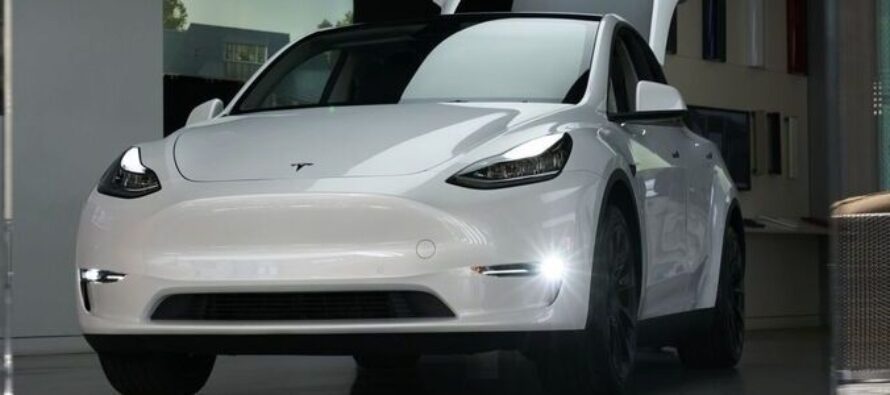
Electric car manufacturer Tesla Inc (NASDAQ: TSLA) reported its fiscal 2022 first-quarter earnings that were nearly eight times higher than the corresponding period of fiscal 2021. Both earnings and revenues surpassed analysts’ estimates. The company also warned that production would be strained for the rest of the year due to scarcity of semi-conductor chips and several other components, but still anticipates boosting deliveries.
Following the exceptional results, the stock of Tesla surged 3.23% or $31.58 to $1,008.73. The increase in share price has bolstered the wealth of Elon Musk, the richest man on earth, to over $260 billion. Interestingly, Musk’s wealth is now $100 billion more than the second richest person, Jeff Bezos, the founder of Amazon.
The Austin, Texas-based Tesla reported first-quarter revenues of $18.76 billion, an increase of 80.60% from $10.39 billion in the similar period last year.
During 1Q 2022, the energy generation and storage systems manufacturer posted earnings of $3.32 billion, or $2.86 per share, compared with $438 million, or $0.39 a share, in 1Q21.
Excluding stock-based compensation expenses and others, Tesla recorded Q1 2022 non-GAAP earnings of $3.73 billion, or $3.22 per share, an increase from $1.06 billion, or $0.93 per share, in Q1 2021.
Refinitiv analysts had anticipated the company to claim earnings of $2.26 per share on revenues of $17.80 billion.
Segment-wise,
- Automotive revenues jumped 87% y-o-y to $16.86 billion.
- Energy generation and storage revenues increased to $616 million in 1Q 2022, from $494 million in 1Q 2021.
- Services and other revenue were $1.279 billion, up 30.17% from last year.
Notably, automotive gross margins hit a record high of 32.90%. The company also received $679 million in the form of regulatory credits. During the March quarter, Tesla delivered over 310,000 cars, reflecting a 68% y-o-y increase. Specifically, Model 3 and Model Y cars accounted for 95% (295,324 units) of deliveries. Musk is optimistic about delivering a 60% increase in production in fiscal 2022, compared with last year.
If there were no supply chain issues, Tesla claimed that it would have delivered more vehicles. The Shanghai production facility remains closed due to COVID-19 restrictions.
In the case of the energy division, the company’s solar installations fell by almost 50% to 48 MW in March 2022 quarter, compared with the prior-year period. During the quarter, Tesla installed lithium-based battery storage systems carrying a capacity of 846 MWh, an increase of 90% on a y-o-y basis.
Furthermore, Tesla anticipates mass production of robotaxi – without steering wheel and pedals – by 2024. Interestingly, Musk has claimed that Tesla’s robot (humanoid), christened Optimus, will command more value than the full self-driving (FSD) electric car business. It costs $12,000 (or $199 per month) as subscription costs for receiving access to the state-of-the-art driver assistance solution. During the company’s maiden AI Day, observed last August, the 5’8” robot (humanoid) was first unveiled. According to Tesla, the robot is capable of performing day-to-day tasks such as grocery purchases, etc.
Tesla refrained from issuing an elaborate outlook for deliveries but stated that it anticipates a multi-year annual growth of 50% and predicted that logistics issues would not remain for the rest of the year.
The robust quarterly earnings upbeat outlook is expected to keep the stock bullish in the short term.
The historical price chart reveals that the stock of Tesla is ascending after consolidating at $750 levels. The next major resistance is anticipated only near 1200. Additionally, the stock is trading above its 50-day moving average, while the MACD indicator has a positive reading. Therefore, we are expecting the stock to remain in an uptrend in the short term.

Disclaimer: Any financial trading analysis offered here is our opinion and is not intended as advice or direction for investors. We cannot guarantee the success of any trades made as a consequence of this article, and we encourage traders to incorporate a strong money management strategy to limit losses when they enter the markets. Please use this article as part of your own research before formulating strategies prior to trading.